I built my first website in 1997, on a 486 PC. (Yes, that dates me.) It was an ad-sharing site: I partnered with online ad networks and passed their ad code on to other website owners, earning a commission on what those ads made. That model later grew into what we now call affiliate marketing. There was no Google back then — most people searched on Yahoo. That little site earned me my first internet income and introduced me to a lot of the people running websites at the time. I've built many more sites since, across different industries and for different purposes. This post is what those years taught me about what a website actually needs.
Over more than twenty years of building websites — some for myself, many for clients — I've watched the same thing happen again and again: a company launches a website, and it does almost nothing for the business.
The cause is usually simple. They finished the pages and stopped. A website that creates real business value is made of four parts that work together:
Page building, content, traffic (SEO and SEM), and lead conversion.
Drop any one of them and the whole system stops working. Here's how I think about each.
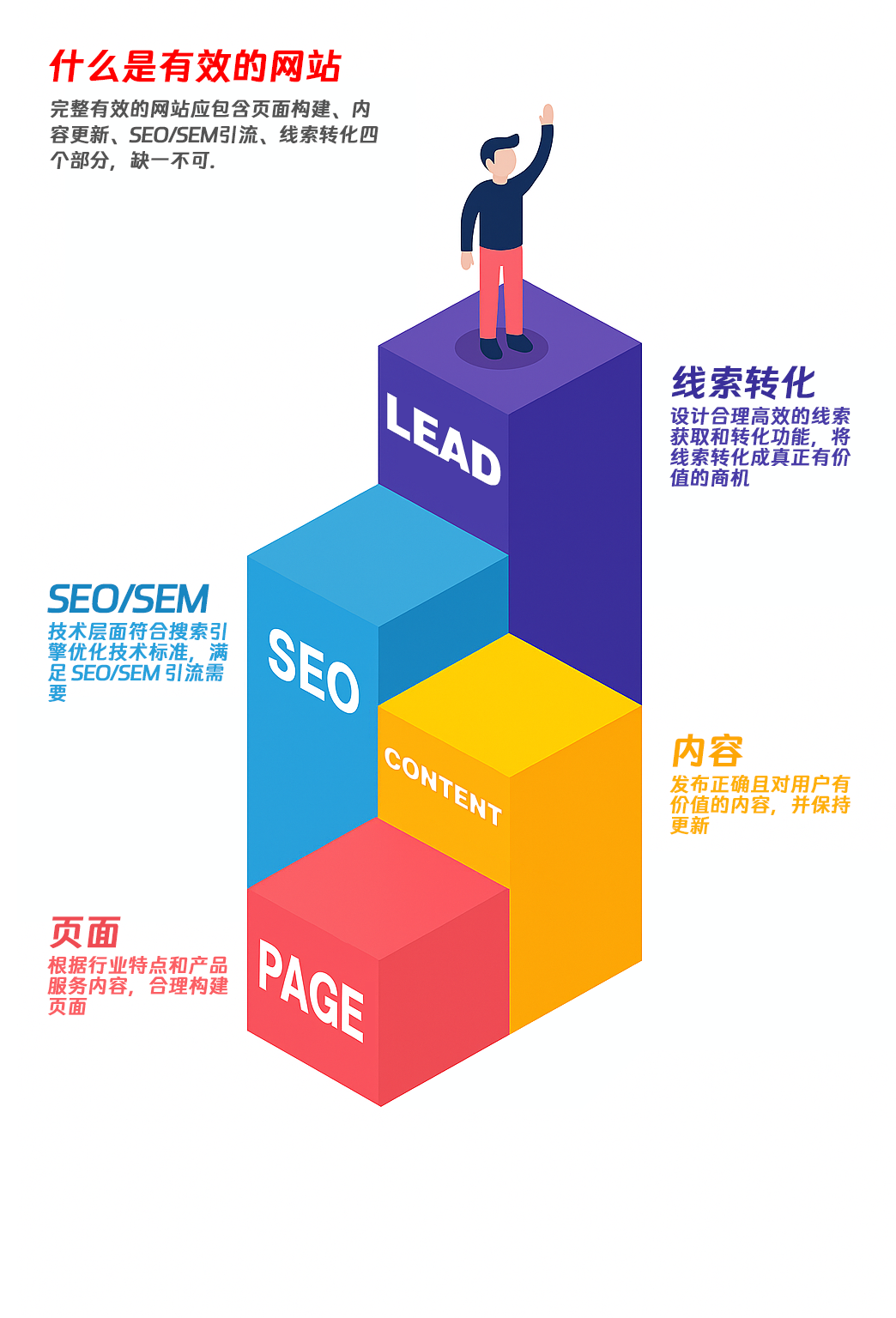
1. Page building is the starting line, not the finish line
Page building is the foundation: the design, structure and functionality of the site. It's where most companies spend most of their energy — is it beautiful, does it look premium, does it work on mobile? Then the pages go live and everyone assumes the job is done.
That's like fitting out a beautiful shop and never opening the doors. Pages are necessary, but without anything happening after launch, they deliver almost no value.
Plenty of business owners don't have a clear idea of what their website is for. Competitors have one, so they get one too — and their main question becomes "does it look good?" Wanting a well-designed site is fine. But when looks are the only goal, the priorities are upside down.
Think of an office or factory building where most of the budget went into the facade, at the expense of the floor plan inside. A website built on "how it looks" ends up looking great and doing very little.
2. Content is what makes a website worth visiting
Content decides whether visitors stay, whether they trust you, and whether they want to learn more about what you sell. A website without content is a blank brochure — it can't tell anyone anything.
Content is also how search engines judge the quality of your site, and it directly affects where you rank.
Many company websites have gone years with nothing beyond an "About us" page and a few product pages. That isn't enough. Websites that work keep publishing useful content: product information, but also industry news, case studies, application notes and FAQs. Every page like that gives visitors a reason to come back — and gives search engines another way in.
Content also has to be updated steadily, and for most companies this is the hardest part. It needs someone who owns it, and it rarely pays off right away — a new article won't bring in business the day it's published. Social media works differently: a post can get picked up by the platform's algorithm and seen within hours. Website content pays off more slowly, and without quick feedback, most teams run out of patience.
But website content lasts far longer. Once an article ranks in search, it tends to stay there, bringing in steady traffic every single day — no algorithm has to pick it up first. On most social platforms, a post gets recommended for a few days and then effectively disappears.
So don't treat content as a chore. Consistent publishing is what keeps a website's value growing. As long as new content keeps coming, the site stays alive.
3. Traffic: go and get visitors instead of waiting for them
Launching a website doesn't bring customers to your door. Traffic has to be earned through search engine optimization (SEO) or bought through search engine marketing (SEM).
SEO is the long game: high-quality content, a sound site structure, ongoing optimization and links from other sites. SEM is closer to buying traffic — you bid on keywords and get visitors quickly. Each has its strengths, and most businesses do best combining the two and shifting the balance as they grow.
I've seen excellent companies with genuinely good content on their websites and no SEO or advertising at all. Nobody ever saw that content. It's a real waste.
4. Lead conversion is where the value finally shows up
In the end, most of us build websites to drive some kind of action — a sign-up, a form submission, an inquiry or a purchase.
Without thoughtful conversion design, even strong traffic quietly slips away. Conversion design covers a lot: where your forms sit and how short they are, how you present your contact details, whether you offer live chat, and whether you give visitors a reason to act — a download, a free trial, an invitation to join a community.
In practice, most websites still stop at "here's our phone number." That leaves it to the visitor to work up the courage to call. It's an inefficient way to do business, and it converts poorly.
Remember that every visitor who finds your site among everything else on the internet is a valuable opportunity. The people who land on your pages are usually highly relevant, high-potential customers. If you don't connect with them while they're there, they may close the tab and never come back.
You have plenty of ways to start that relationship: a clear call to action on your landing pages, an email newsletter, a sign-up prompt, a live chat window. These are the tools that keep a visitor from simply leaving. Don't let hard-won traffic go to waste — always give visitors a next step.
I've always believed that a website's real value isn't in its traffic numbers. It's in how much of that traffic turns into leads, customers and orders.
A business website is an online business system
Put the four parts together and you get a complete loop:
Page building → Content → Traffic → Lead conversion
Most companies stop at "building the website" and never move on to running it. A website's value depends on whether it keeps working over time — whether it keeps producing leads and orders.
I hope this helps you see what a website is really for. A website isn't money spent on a nice storefront. It should be your company's most important digital channel for doing business.
Start from a structure that already works
Every iHomepage CMS template ships with an SEO-ready page structure and multilingual publishing built in — pick one for your industry and start publishing.
Browse templates