Slate House
A colorful contemporary home retail company template combining products, spaces, services, and stores
A colorful contemporary home retail company template combining products, spaces, services, and stores
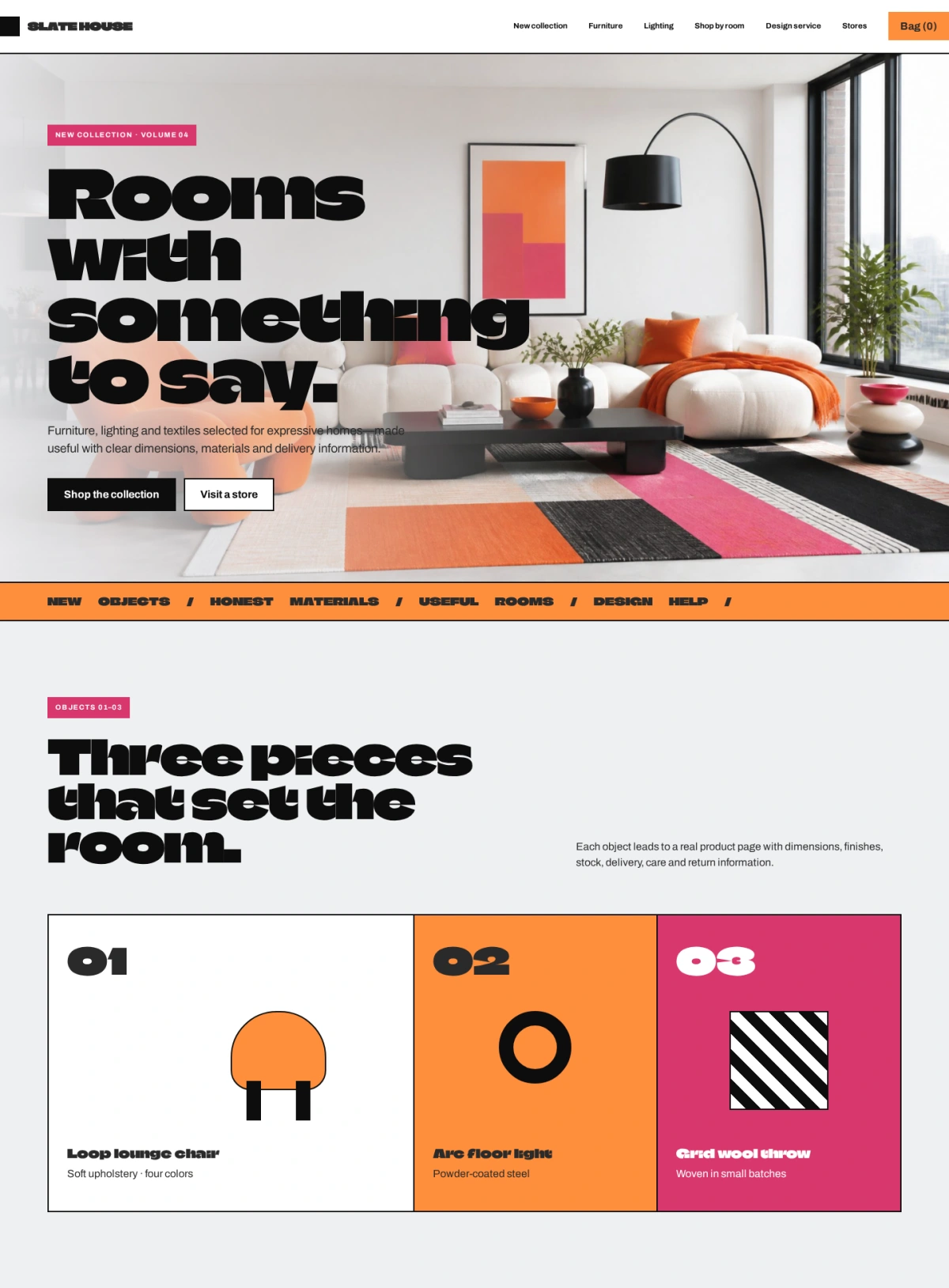
Slate House treats retail as an act of curation rather than a conventional catalog. A styled-room hero, numbered HTML product objects, color-blocked room navigation, a practical design-service journey, and store information create direct paths to collections, help, and physical locations. The visual system uses only Happy Hues Palette 9: light gray supports the editorial canvas, near-black anchors typography and borders, orange drives collection energy, white separates product information, and rose marks seasonal emphasis. A single solid black square forms the intentionally simple logo without dots or secondary geometry.
Choose this template for an independent retailer or design company that wants to sell products while communicating a recognizable point of view. It is especially suitable for furniture stores, home accessory brands, lighting showrooms, textile retailers, concept stores, interior design studios with product collections, and lifestyle businesses that operate both online and through physical locations. The design assumes that customers are attracted by curation, color, materials, and the relationship between objects rather than by a dense marketplace catalog. It is most effective when the business has strong original photography and a limited set of meaningful collections.
Replace the SLATE HOUSE wordmark with a simple transparent logo that can remain legible over cream and photographic backgrounds. A compact black or dark-brown SVG works well. Avoid an overly detailed emblem in the header because the page already uses large expressive typography. Define the visual identity before adding products: select four or five coordinated colors, one display typeface, one highly readable interface typeface, and consistent image lighting. The sample palette is intentionally bold, but it can be adapted to the brand as long as contrast and hierarchy remain clear. The hero should introduce a current collection, seasonal idea, or enduring brand promise.
Use a real styled interior with products that are actually available, then connect the headline to a collection page or store visit. Do not use a beautiful room image that contains items customers cannot identify. Tag featured objects where practical and state when styling props are not sold. The numbered object strip is designed for a small group of signature products. Keep camera angles, shadows, and scale visually compatible, provide short names and prices on the destination page, and replace generated product cutouts with accurate photography. The Shop by Room area should help customers browse according to intent.
Create separate landing pages for living, dining, bedroom, workspace, or other relevant spaces, but avoid duplicating identical product grids across them. Each room page can combine a styled environment, recommended product groupings, dimensions, material guidance, care information, and links to related services. If ecommerce is enabled, product pages need accurate stock status, variants, dimensions, delivery regions, assembly requirements, returns, warranty, and clear photography from several angles. Do not hide essential purchasing information inside images. The editorial story section can introduce designers, makers, materials, responsible sourcing, or the company's buying philosophy.
Use names and claims that can be verified, secure permission for portraits, and distinguish original designs from third-party brands. The material palette is useful for communicating finishes and texture, but colors shown on screens should not be presented as exact. Offer samples where appropriate and add a note about natural variation. Use Design Service for consultations, room planning, trade support, or styling appointments. Explain what is included, whether the service is free or paid, what customers should prepare, and what happens after booking. Store pages should include current addresses, opening hours, accessibility information, parking or transit guidance, phone numbers, and photographs of the actual location.
For local SEO, give each store a unique page with accurate business structured data. Create unique metadata for collections, rooms, services, and stores, and use descriptive alternative text rather than keyword stuffing. Optimize large interior photographs into responsive WebP or AVIF files and provide intrinsic dimensions to prevent layout shift.
On mobile, keep the color-blocked room navigation usable with large touch targets and make product names accessible without relying on hover. Add privacy choices before optional analytics or advertising pixels, and explain newsletter frequency before signup.
Before launch, replace all sample inventory, verify prices and availability, test checkout or inquiry flows, confirm delivery policies, add privacy and terms pages, and review every image license. With a disciplined catalog and a coherent photographic system, this template can make a small retail company feel like an influential design destination while still helping customers find products, services, and stores quickly.