COMMONWELL PHARMACY
A community pharmacy template that routes prescription tasks, booked health services, pharmacist advice, and urgent-care boundaries clearly
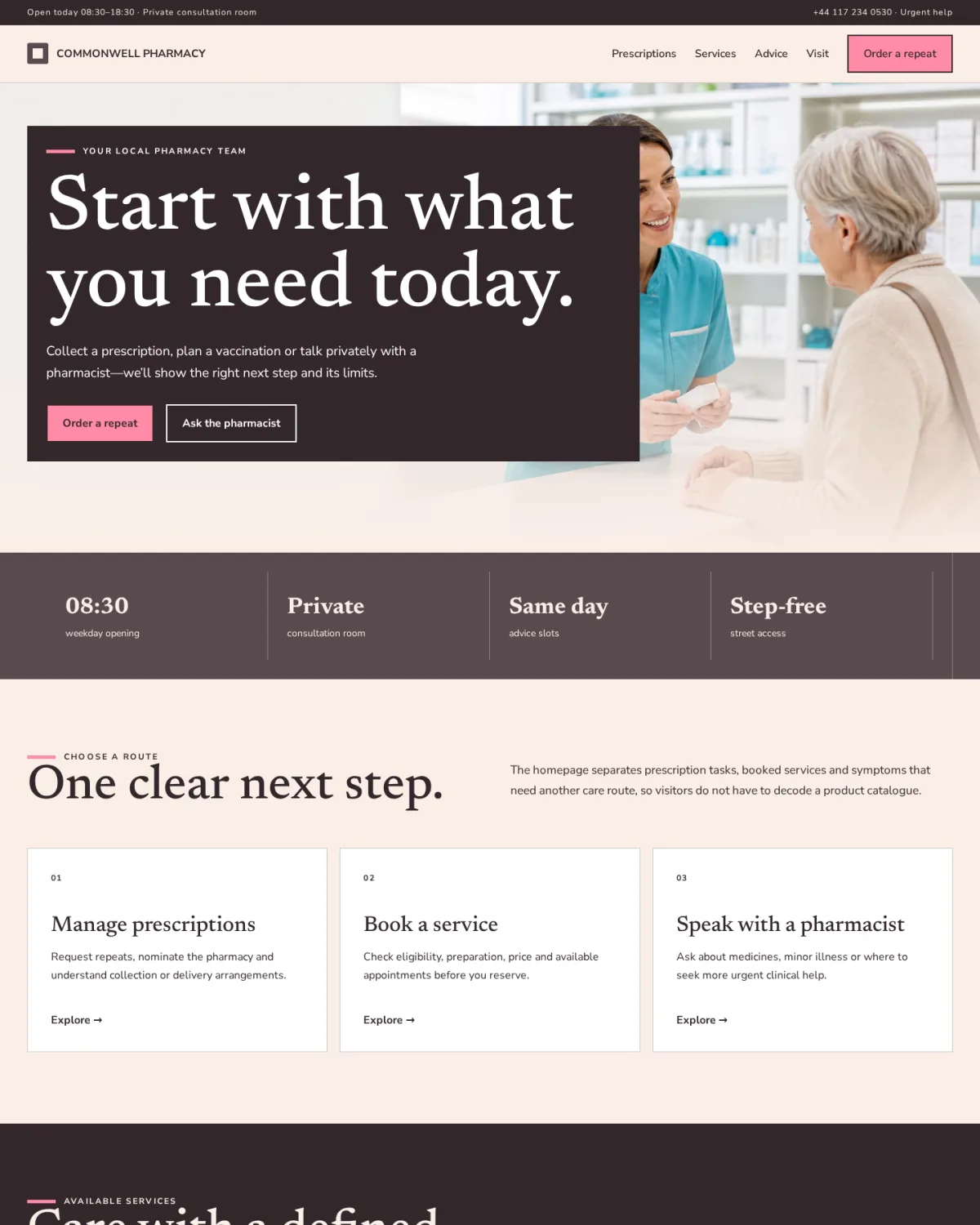
A community pharmacy template that routes prescription tasks, booked health services, pharmacist advice, and urgent-care boundaries clearly
Commonwell uses a warm cream, white, charcoal, muted plum, and pink Happy Hues palette to avoid an impersonal clinical aesthetic. A soft photographic hero leads to three task-based routes rather than a retail shelf. Clear scope language, service rows, access facts, and a recurring ring motif help visitors understand what the pharmacy can do and when another care route is more appropriate.
Choose this template for an independent community pharmacy, pharmacy group location, vaccination clinic, medicines support service, travel-health pharmacy, or health service operating within a pharmacy setting.
Replace the Commonwell identity with the pharmacy’s approved trading name and transparent logo, and prepare a white version for dark surfaces. Keep the selected Happy Hues palette or map approved identity colors to semantic variables, then verify contrast for body text, clinical notices, links, buttons, focus states, errors, disabled controls, and hover states.
Replace the generated consultation image with licensed photography of the actual premises, registered professionals, consultation room, access route, and service experience. Obtain written consent, remove patient names, prescription labels, addresses, computer screens, dispensing records, and identifiable health information. Never use generated people, uniforms, medicines, shelves, equipment, or rooms to imply real staff, stock, facilities, registration, accreditation, or clinical capability.
Rewrite the hero around the real location, opening hours, commissioned services, private services, prescription arrangements, and contact routes. Every demonstration time, service, availability statement, access claim, telephone number, and response expectation is fictional and must be connected to maintained data or replaced. Clearly distinguish a repeat request, prescriber authorization, dispensing, stock confirmation, collection readiness, delivery, clinical consultation, appointment request, confirmed booking, and emergency route. Do not promise that a medicine is available, a prescription will be approved, a service is suitable, a condition will improve, or advice replaces assessment by an appropriate clinician.
Prescription pages should explain nomination, electronic and paper workflows, controlled-drug limitations, identity checks, collection by another person, storage, delivery area, charges, missed delivery, disposal, shortages, owing items, private prescriptions, and what to do when urgent supply is needed. Never expose medicine names or patient details in confirmation URLs, analytics, ordinary email, or public screens. Service pages must state eligibility, exclusions, age range, preparation, consent, records shared, price, appointment length, possible outcomes, follow-up, cancellation, side effects where relevant, red flags, and referral pathways.
Content should be reviewed by registered professionals and aligned with current national guidance, local commissioning, professional standards, product authorization, safeguarding, infection control, and advertising rules. Urgent-help content must identify symptoms that require emergency services, urgent clinical advice, a prescriber, or another provider, while making the website’s limits explicit. Do not use a chatbot as the sole route for time-critical needs. Team profiles require verified names, registration details where appropriate, roles, scope, languages, and current photographs. Claims about same-day service, stock, delivery, waiting time, vaccination availability, clinical outcomes, customer numbers, reviews, awards, accessibility, sustainability, or years of experience require evidence, dates, scope, and ownership.
Never invent testimonials, regulator marks, NHS or insurer relationships, ratings, awards, patient counts, or success rates.
For SEO, create substantial pages for genuine services, prescription processes, medication support, vaccination, travel health, minor illness, access, opening hours, and location. Use unique titles and descriptions, canonical URLs, logical headings, clinical authorship and review dates, meaningful internal links, sources where useful, and accurate alternative text. Apply Pharmacy, MedicalBusiness, Service, FAQPage, or Article structured data only when the visible page supports every property.
If multilingual, use qualified health translators and clinical reviewers for symptoms, medicines, consent, risks, eligibility, emergency instructions, privacy, complaints, and prices.
On mobile, keep prescription, call, directions, booking and urgent routes visible, allow long medicine and service names to wrap, and never hide safety information behind hover. Maintain semantic landmarks, heading order, keyboard access, visible focus, large touch targets, zoom support, high contrast, reduced-motion behavior, form labels, accessible errors, and useful alternatives for images. Collect only the minimum information needed for routing and use secure systems for prescriptions, health information, identity, payment, consent, and records.
Before launch, replace every fictional person, service, opening time, price, claim, address, link and photograph; test prescription and appointment workflows, telephone and email links, failures, screen readers, keyboard use, mobile and ultrawide layouts, slow networks, reduced motion, consent and browsers. Add reviewed privacy, cookies, terms, clinical disclaimer, urgent help, safeguarding, complaints, accessibility, delivery, cancellation, records, confidentiality and contact pages with named clinical, operational, privacy, accessibility and content owners.