FOLD PACKAGING
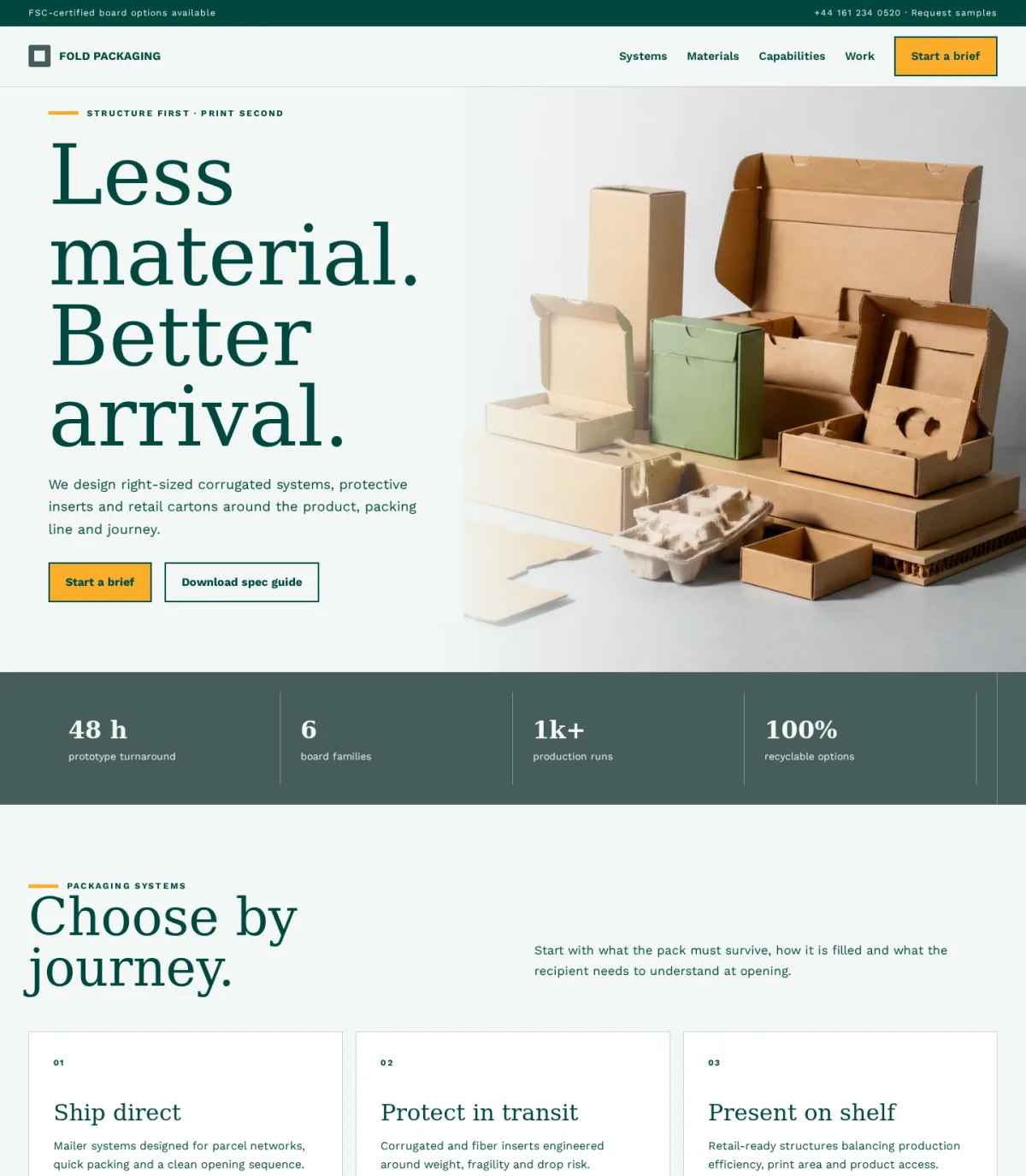
A structural packaging manufacturer template organized around distribution journeys, materials, prototyping, testing, and production readiness
A structural packaging manufacturer template organized around distribution journeys, materials, prototyping, testing, and production readiness
Fold applies a green, white, amber, and dark teal Happy Hues palette to a product-catalog layout. The hero pairs generous technical whitespace with a family of real packaging structures. The content then organizes services by distribution journey rather than vague benefits, followed by a gated production path. Repeated square geometry, hard rules, and numbered rows echo dielines and corrugated construction without turning the page into a poster.
Choose this template for a corrugated packaging manufacturer, structural design studio, protective-packaging supplier, folding-carton producer, molded-fiber specialist, contract packer, or packaging engineering consultancy.
Replace the Fold identity with the organization’s approved name and a simple transparent logo. Prepare a light version for dark footer surfaces and verify that the mark remains clear at small sizes. Keep the selected Happy Hues palette or map approved brand colors to semantic CSS variables, then test text, links, buttons, borders, form states, focus, errors, disabled controls, and hover states for accessible contrast.
Replace the generated product arrangement with licensed photographs of actual packaging structures, materials, prototypes, converting equipment, testing facilities, packing lines, and completed customer work. Remove customer names, artwork, barcodes, addresses, shipping labels, confidential dielines, dimensions, patents, and unreleased product information. Never use generated boxes or equipment to imply real production capability, certifications, customers, tolerances, test results, or intellectual property.
Rewrite the hero around the real manufacturing footprint, design process, run sizes, regions served, and core material expertise. The demonstration turnaround, run-size, material, and recyclability figures are fictional placeholders and must be replaced with evidence or removed. Do not promise damage elimination, guaranteed savings, universal recyclability, lower carbon impact, faster packing, exact lead times, or compatibility with every distribution route. Explain which services are provided in-house, which are subcontracted, and where tooling, print, testing, fulfillment, storage, or transport involve third parties.
System pages should document suitable product types, dimensional range, board or substrate options, flute, coating, print process, closure, insert, assembly, packing method, pallet constraints, order quantity, tooling, tolerance, storage, shelf life, lead time, and disposal route. Clearly separate a concept, prototype, indicative sample, pre-production sample, approved specification, and production batch. Materials pages need current supplier and certification evidence, recycled and virgin content definitions, chain-of-custody scope, food-contact status, barrier chemistry, coatings, adhesives, inks, recyclability assumptions, local collection limitations, composting conditions, and any contamination constraints.
Avoid broad terms such as sustainable, plastic-free, biodegradable, circular, carbon-neutral, or fully recyclable unless the claim has a defined boundary, method, location, date, and supporting evidence. Testing pages should identify the standard, sample conditioning, pack configuration, product substitute, orientation, drop sequence, compression load, vibration profile, acceptance criteria, laboratory status, report ownership, and limits of predictive value. Do not imply that an internal demonstration is an independent certification. Case studies require customer permission and should state the starting constraint, alternatives considered, verified result, measurement period, production volume, and factors that limit comparison.
Never invent customer logos, testimonials, savings, damage reductions, awards, certifications, patents, machine counts, capacity, or delivery performance.
For SEO, create substantial pages for real systems, substrates, sectors, processes, testing, capabilities, case studies, and service locations rather than thin keyword permutations. Use unique titles and descriptions, canonical URLs, clear headings, meaningful internal links, updated technical data, and accurate alternative text. Apply Organization, Product, Service, Offer, FAQPage, or Article structured data only when visible content supports every property.
If multilingual, use qualified technical translators for material specifications, safety, compliance, tooling, delivery and commercial terms.
On mobile, preserve the sequence from journey to system to specification to brief. Let tables and dimensions scroll or reflow without clipping, keep inquiry actions reachable, and do not hide essential specification facts behind hover. Maintain semantic landmarks, heading order, keyboard access, visible focus, large touch targets, high contrast, reduced-motion support, labeled forms, accessible errors, and meaningful image descriptions. A project form should request only enough information for triage and provide a secure route for confidential drawings and files. State permitted formats, size limits, retention, recipients, intellectual-property treatment and deletion.
Before launch, replace every fictional claim, number, material, test, address, link, photo and contact; test forms and uploads, telephone and email links, validation failures, keyboard and screen-reader use, zoom, mobile and ultrawide layouts, slow networks, reduced motion, consent controls and browsers. Add reviewed privacy, cookies, terms, IP and confidentiality, samples, tooling ownership, tolerances, artwork approval, delivery, cancellation, complaints, sustainability claims and contact pages with named engineering, quality, commercial, privacy, accessibility and content owners.