Juniper Legal Counsel
A restrained legal counsel company template with confidential intake, matter workflow, representative cases, and transparent engagement guidance
A restrained legal counsel company template with confidential intake, matter workflow, representative cases, and transparent engagement guidance
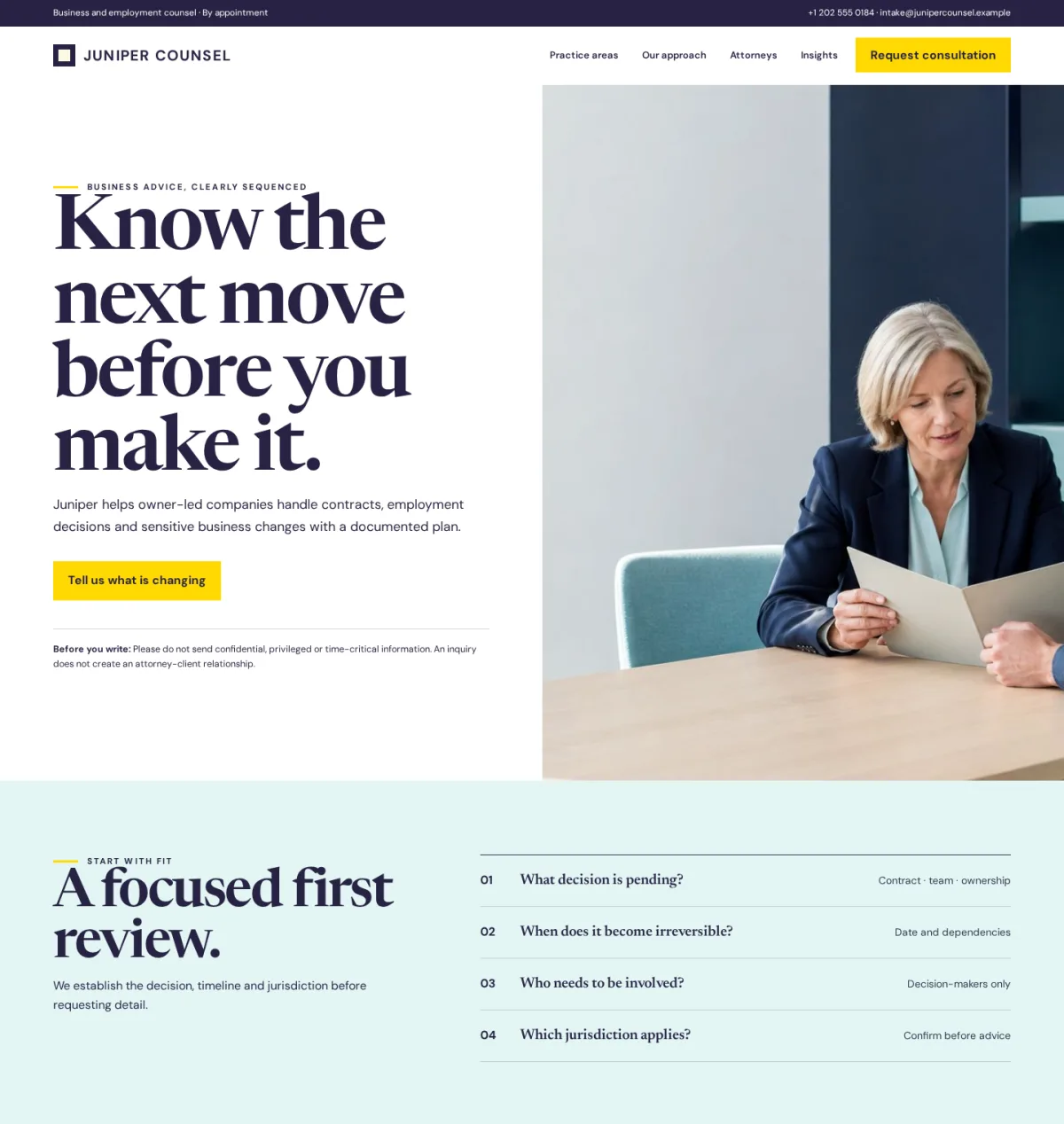
Juniper replaces courtroom symbolism and generic practice cards with a consultation-led split hero, a five-stage matter workflow, evidence rows, representative matter sequences, a credentials ledger, fee expectations, insights, and FAQs. The restrained editorial hierarchy feels credible while remaining straightforward to implement in semantic Bootstrap-compatible HTML.
Choose this template for a boutique law firm, business counsel practice, employment lawyer, investigations team, compliance advisor, or specialist professional-services company.
Replace the Juniper identity with a transparent logo and compact monochrome variants for the header, footer, documents, and mobile menu. Preserve the shared alignment axes, measured typography, consistent gutters, restrained color system, and clear division between information and action. The intake form should request only enough information to route an inquiry and must warn visitors not to send confidential, privileged, sensitive, or time-critical details before an engagement is confirmed. Explain who receives submissions, expected response timing, conflicts checks, jurisdiction limits, and emergency alternatives.
Never state that submitting a form creates an attorney-client relationship. Practice pages should define scope, typical issues, audience, process, exclusions, jurisdictions, and next steps without promising outcomes. Representative matters must be anonymized or published with permission, and problem-action-outcome summaries should avoid invented financial amounts, guarantees, or implications that past results predict future performance. Attorney biographies need verified names, licenses, admissions, education, roles, experience, languages, and current disciplinary or advertising disclosures where required.
Claims about rankings, awards, clients, case volumes, success rates, years of experience, certifications, or specialist status must be accurate, dated, and permitted by relevant rules. Fee guidance should explain billing models, retainers, expenses, taxes, payment timing, scope changes, and when a tailored quote is necessary. Do not describe pricing as transparent while withholding essential conditions. Replace all generated attorney and client photography with authentic licensed images before launch. Obtain releases, remove documents and screens that expose client information, and do not use imagery to imply personnel, offices, clients, diversity, courtroom experience, or capabilities that do not exist.
Keep legal text, credentials, disclaimers, dates, controls, and actions as editable HTML. Provide descriptive alternative text without inferring a person's legal problem.
For SEO, build substantial pages for genuine practice areas, jurisdictions, industries, attorney profiles, processes, and reviewed insights. Use unique titles, descriptions, canonical URLs, logical headings, author names, review dates, and helpful internal links. Avoid thin pages for every city-keyword combination or mass-generated legal articles. Apply LegalService, Organization, Person, Article, or FAQ structured data only when visible information matches.
If multilingual, use qualified legal translation for terminology, disclaimers, jurisdiction statements, forms, and privacy notices.
On mobile, stack the intake fields in order, convert workflows and case rows into readable sequences, keep type sizes comfortable, and prevent tables from overflowing. Maintain keyboard access, visible focus, sufficient contrast, large touch targets, reduced motion, labeled accordions, and clear form errors. Optional analytics, chat, scheduling, video, maps, and social embeds should remain disabled until consent where required, and sensitive inquiry pages should minimize tracking.
Before launch, replace all fictional attorneys, matters, offices, awards, dates, contacts, photographs, fees, and claims; test inquiry routing, conflicts language, forms, validation, spam handling, keyboard use, screen readers, responsive layouts, performance, privacy choices, and failure states. Add reviewed privacy, terms, accessibility, attorney advertising, disclaimer, conflicts, complaints, retention, security, and contact information. Assign legal and content owners with review schedules so biographies, admissions, laws, insights, and disclosures remain current.