MOSS RECOVERY CLINIC
A calm mental-health service template with private eligibility, urgent support, stepped care, credentials, and payment guidance
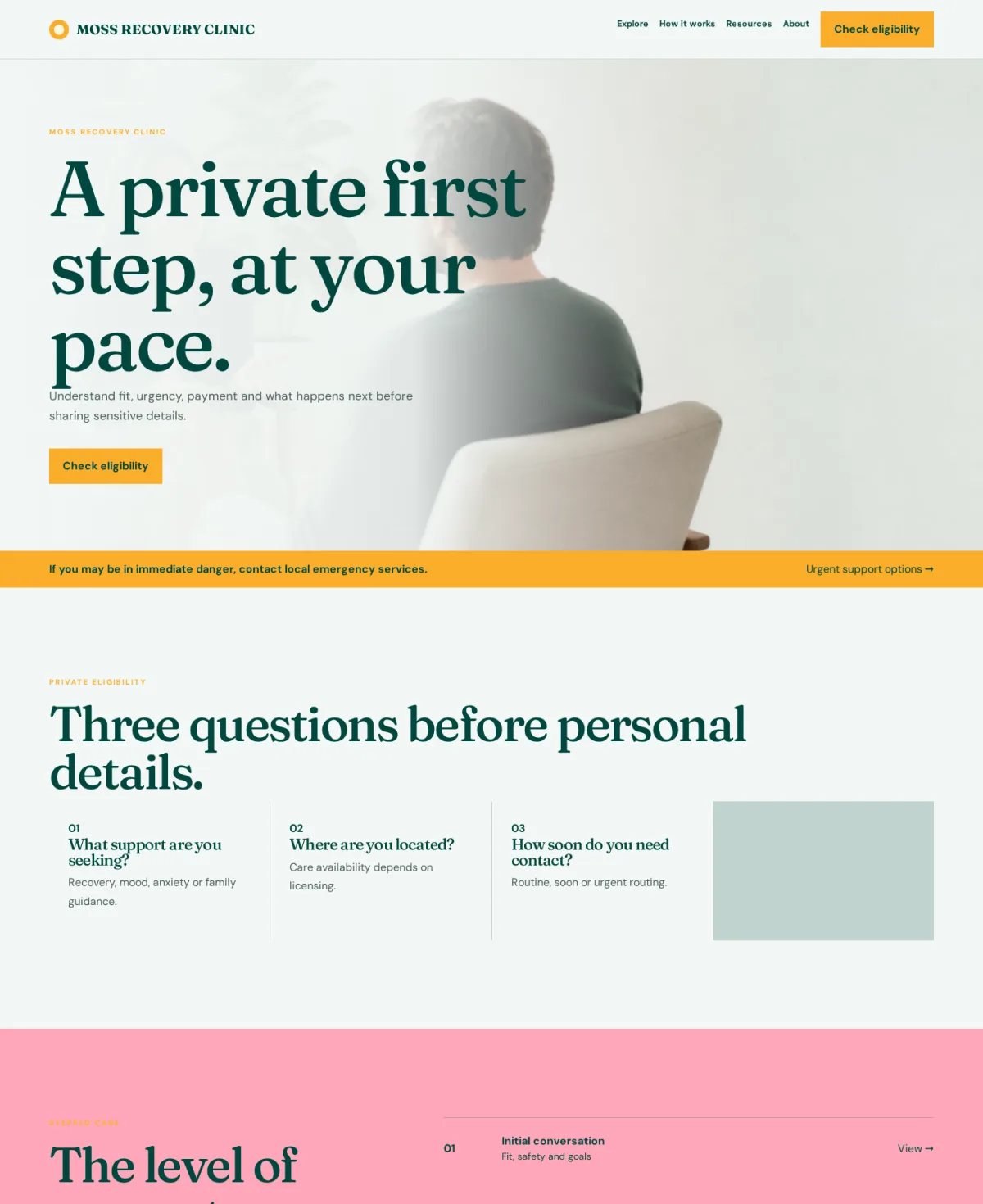
A calm mental-health service template with private eligibility, urgent support, stepped care, credentials, and payment guidance
Moss organizes the homepage around safety and practical access rather than wellness imagery. A private eligibility step and urgent-help strip lead into a four-stage support pathway, needs-based services, clinician credentials, expectations, coverage, privacy, and FAQs using a quiet but precise Bootstrap grid.
Choose this template for a mental-health clinic, counseling group, recovery program, behavioral health provider, trauma service, or coordinated support organization.
Replace the Moss identity with a transparent logo and compact variants for the utility header, mobile navigation, forms, and footer. Preserve the calm container alignment, generous whitespace, restrained colors, consistent gutters, and clear urgent-help hierarchy. Eligibility interfaces should route people to appropriate next steps, not diagnose conditions, calculate risk, or promise acceptance. Explain what information is requested, who receives it, response timing, service area, age limits, exclusions, and what to do when urgent help is needed. Crisis and emergency routes must be local, current, prominent, and reviewed regularly; do not imply that a website form, email, or delayed callback is suitable for immediate danger.
Service pages should state audience, approach, setting, duration, clinician type, evidence basis, limitations, cost, availability, and referral requirements in plain language. Avoid guarantees, recovery timelines, cure claims, or language that stigmatizes people. Clinician biographies need verified licenses, jurisdictions, qualifications, roles, languages, supervision, and current availability. Claims about evidence-based care, outcomes, accreditation, insurance participation, waiting times, privacy, capacity, or years of experience must be accurate and scoped. Payment information should explain insurance verification, deductibles, copays, self-pay rates, deposits, cancellations, financial assistance, and circumstances that change cost.
Never invent testimonials, outcomes, clinicians, facilities, coverage, or credentials.
Replace generated clinician, client, interior, and team imagery with authentic licensed assets before launch. Obtain informed releases, protect identities, and never use real care sessions merely for marketing. Generated imagery must not imply staff, locations, programs, accessibility, or treatment environments that do not exist. Keep urgent instructions, eligibility questions, credentials, privacy language, prices, and controls as editable HTML. Alternative text should describe settings without inferring diagnosis, trauma, or recovery status.
Forms should minimize sensitive data and move clinical histories, identity records, insurance documents, payments, and assessments into a secure authenticated workflow with appropriate consent, retention, access, and breach procedures.
For SEO, create substantial reviewed pages for actual services, audiences, approaches, clinicians, locations, payment guidance, and educational resources. Use unique titles, descriptions, canonical URLs, logical headings, authors, clinical reviewers, dates, and internal links. Avoid mass-produced symptom pages or content that presents general information as personalized advice. Apply MedicalOrganization, Physician, Person, Article, or FAQ structured data only when visible details match and jurisdiction permits.
If multilingual, use qualified clinical translation for terminology, safety instructions, consent, forms, and local resources.
On mobile, keep crisis actions visible without blocking content, stack forms in reading order, turn timelines into vertical sequences, and preserve comfortable type. Maintain keyboard access, visible focus, strong contrast, large targets, reduced motion, screen-reader labels, and clear errors. Optional analytics, chat, video, scheduling, and social embeds should respect consent, privacy, and the sensitivity of visits.
Before launch, replace all fictional clinicians, services, contacts, costs, images, availability, and claims; test urgent routing, eligibility, forms, validation, scheduling, keyboard use, screen readers, responsive layouts, performance, consent, and failures. Add reviewed privacy, terms, accessibility, clinical disclaimer, crisis, consent, records, payment, cancellation, complaints, safeguarding, and contact pages, with clinical, privacy, and content owners and frequent review schedules.