Northstar Insurance Advisory
A practical commercial insurance advisory template structured around operational risk, policy comparison, claims support, and accountable advice
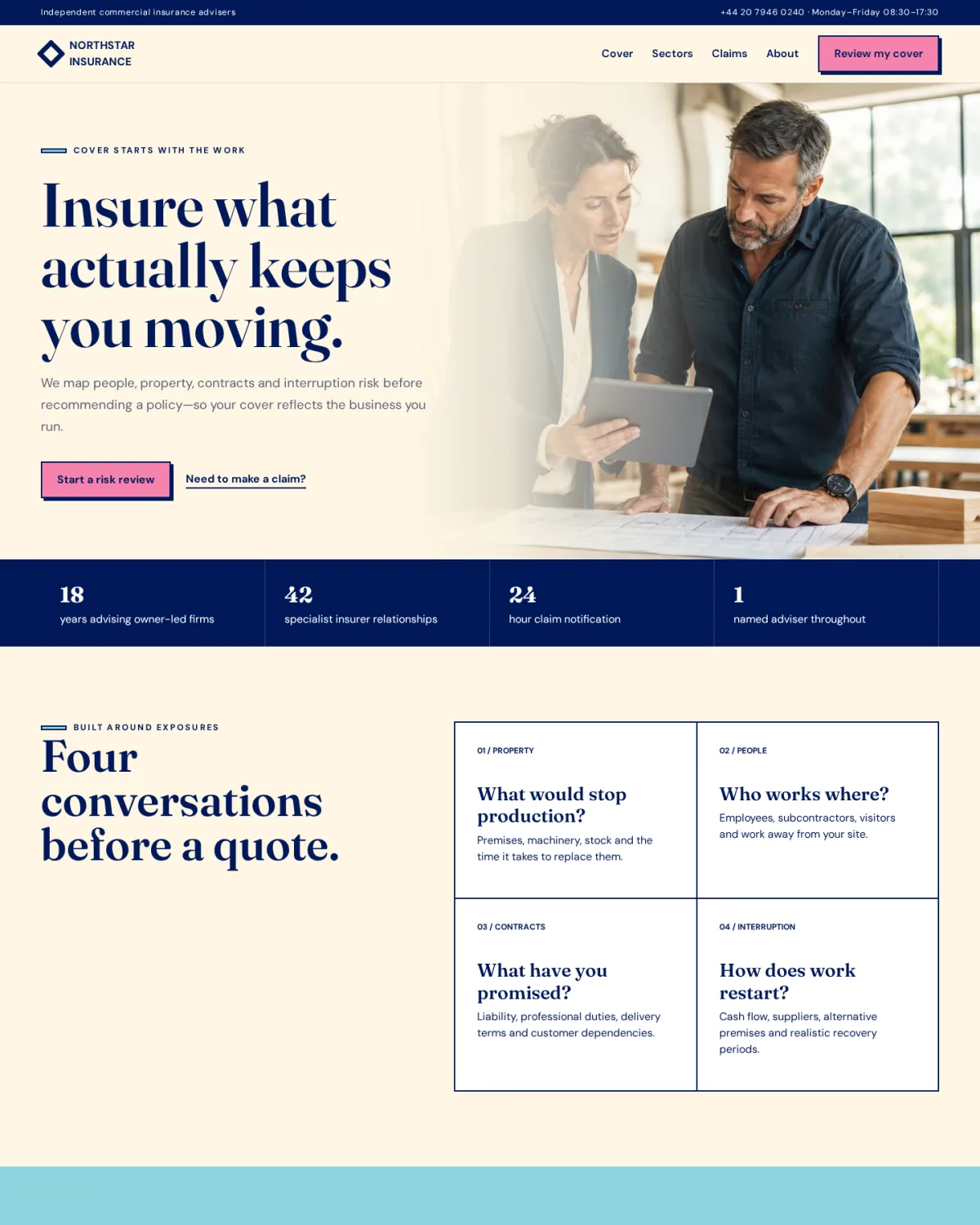
A practical commercial insurance advisory template structured around operational risk, policy comparison, claims support, and accountable advice
Northstar uses Happy Hues Palette 2 with a navy structural system, cream content surfaces, coral actions, pale blue process areas, and one square-ring signature. Instead of presenting insurance as a list of products, the page begins with how a business works and organizes the offer around property, people, contracts, and interruption. Strong grid borders, visible numbered steps, and plain-language evidence make a complex advisory service feel traceable and concrete.
Choose this template for an independent commercial insurance broker, risk adviser, employee-benefits consultancy, specialist underwriting agency, or professional firm serving owner-led businesses.
Replace the Northstar identity with the organization’s approved name and transparent logo. Keep the mark simple enough to remain legible at small navigation sizes, and prepare a light version for dark surfaces. The colors in this demonstration follow Happy Hues Palette 2; when adapting the brand, map approved colors to semantic CSS variables and verify contrast for text, links, buttons, borders, focus states, errors, disabled controls, and hover states.
Replace the generated hero with licensed photography of the real advisers and relevant client environments. Obtain releases and remove confidential plans, customer names, screens, policy documents, addresses, claim information, and other identifiable business data. Never use a generated scene to imply a real client relationship, site visit, accreditation, insurer partnership, or operational capability.
Rewrite the hero around the firm’s real service area, client profile, authorization status, and method of advice. The demonstration facts, insurer relationships, response times, telephone number, and experience figures are fictional placeholders and must be removed or replaced with verifiable information. Do not promise that cover is comprehensive, claims will be paid, premiums will fall, a quotation will be available within a fixed period, or a particular insurer will accept a risk. Explain whether the business offers advice, introduces customers, arranges cover, administers policies, supports claims, or performs regulated activities, and use the precise disclosures required in each operating jurisdiction.
Clearly distinguish an initial conversation, a risk review, a quotation request, policy placement, renewal, and claim notification. Build sector pages only for industries the team genuinely understands. Each should describe typical operations, material exposures, common evidence requested, practical controls, relevant policy categories, important exclusions, and when specialist assessment may be required. Product and policy pages should explain scope, limits, excesses, conditions, warranties, exclusions, territorial boundaries, retroactive dates, claims-made wording, cancellation, payment, tax, and the fact that final terms depend on underwriting.
Avoid presenting illustrative limits or examples as recommendations. Downloadable checklists should be reviewed, dated, versioned, and framed as general information rather than individualized legal, financial, safety, or insurance advice. Claims content should show the real notification route, operating hours, emergency mitigation expectations, evidence requirements, escalation process, and limits of the adviser’s authority. Do not tell customers to admit liability, delay urgent safety action, discard damaged property, or compromise legal rights. Provide insurer emergency contacts where appropriate and explain what happens outside business hours.
Team profiles require verified names, roles, qualifications, registrations, experience, and current photographs. Claims about independence, market access, savings, response times, renewal retention, claim outcomes, customer numbers, ratings, awards, sustainability, cyber expertise, or sector specialization require evidence, scope, dates, and applicable disclosures. Never invent testimonials, insurer logos, regulator references, client lists, awards, or performance statistics.
For SEO, create substantial pages for genuine sectors, services, claims guidance, risk-management resources, locations, and advisers. Use unique titles and descriptions, canonical URLs, clear headings, meaningful internal links, authorship and review dates for technical guidance, and accurate alternative text. Apply Organization, FinancialService, InsuranceAgency, Service, FAQPage, or Article structured data only when visible content supports every property.
If multilingual, use qualified translators and regulated-content reviewers for disclosures, product terms, claims instructions, complaints, privacy, and legal wording.
On mobile, preserve the sequence from business context to risk categories to process and contact. Keep claim and telephone actions easy to reach, allow long policy terms to wrap, and never rely on hover alone. Maintain semantic landmarks, correct heading order, visible keyboard focus, sufficient touch targets, high contrast, reduced-motion support, form labels, accessible validation, and meaningful image alternatives.
Forms should collect only information required for routing. Do not request complete policy schedules, financial records, identity documents, medical details, passwords, or sensitive claim evidence through ordinary email. Use secure, access-controlled systems with clear recipients, retention, lawful basis, response expectations, and breach procedures.
Before launch, replace every fictional name, number, claim, address, link, date, and photograph; test telephone and email links, forms and failure states, keyboard and screen-reader navigation, zoom, mobile and ultrawide layouts, reduced motion, slow networks, consent controls, and major browsers. Add reviewed privacy, cookies, terms, regulatory disclosure, complaints, accessibility, conflicts, remuneration, claims, security, and contact pages with named business, compliance, privacy, accessibility, and content owners and scheduled review dates.