NUCLEUS DATA
A data infrastructure template centered on capacity, service boundaries, operational control, recovery, security, and accountable ownership
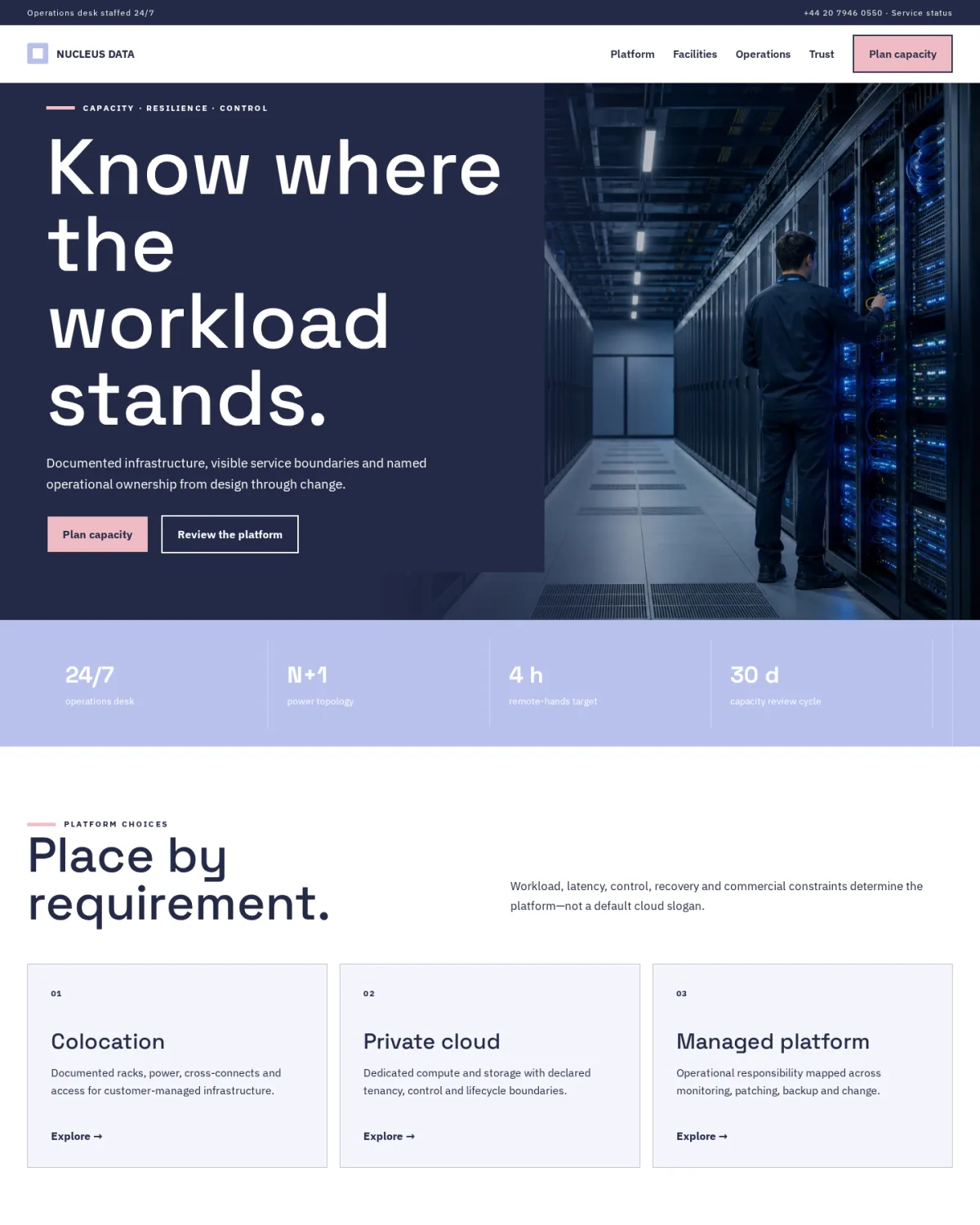
A data infrastructure template centered on capacity, service boundaries, operational control, recovery, security, and accountable ownership
Nucleus applies a dark navy, white, periwinkle, and pale pink Happy Hues palette to an infrastructure dashboard narrative. The hero creates depth without allowing text to drift on ultrawide screens. Platform choices are framed by workload requirements, followed by operational ledgers for capacity, change, recovery, and access. Strong linear geometry and a square-ring signature echo rack units and controlled boundaries.
Choose this template for a colocation provider, data-center operator, private-cloud platform, managed infrastructure company, network service provider, disaster-recovery specialist, or enterprise technology consultancy.
Replace the Nucleus identity with the approved organization name and a simple transparent logo, with a white version for dark surfaces. Retain the selected Happy Hues palette or map approved brand colors to semantic variables, then verify contrast for all text, links, diagrams, buttons, status states, focus, warnings, errors, disabled controls, and hover states.
Replace the generated data-hall scene with licensed photographs of real facilities, operations teams and approved equipment. Remove customer identifiers, rack labels, serial numbers, screens, badges, access controls, floor plans, cable routes, security devices and other sensitive infrastructure information. Never use generated racks, facilities or staff to imply real sites, capacity, topology, certifications, uptime, security, customers or operating capability.
Rewrite the hero around the actual locations, service model, workload profile, ownership boundary and engagement route. Every demonstration availability, topology, response time, staffing and review interval is fictional and must be verified or removed. Do not promise uninterrupted service, zero data loss, absolute security, fixed response or recovery, unlimited capacity, regulatory compliance by default, or outcomes controlled by customers and third parties. Platform pages should state service scope, location, tenancy, power, cooling, rack, compute, storage, network, cross-connect, addressing, remote hands, monitoring, patching, backup, replication, encryption, key ownership, access, support hours, escalation, maintenance, lifecycle, portability, billing and termination.
Clearly distinguish designed capacity, installed capacity, sellable capacity, contracted capacity and currently available capacity. Describe shared responsibility in plain language for infrastructure, hypervisor, operating system, applications, identity, data, backups, monitoring, vulnerabilities, incidents and recovery. Facility claims need defined site scope and evidence for power path, cooling, fire detection, suppression, flood, physical security, access logs, carrier diversity, maintenance, fuel, environmental monitoring, and location risk. Do not publish details that materially increase security exposure.
Security and compliance pages must identify the exact legal entity, service, facility, control boundary, audit standard, certificate period, exclusions, report availability and customer responsibilities. A certification is not proof that every workload or configuration complies. Explain incident notification, severity, evidence preservation, communications, status updates, post-incident review and customer obligations without exposing exploitable procedures. Recovery pages should state recovery time and point objectives as design targets or contractual commitments only where supported, along with dependencies, exclusions, last-test date, test method and unresolved findings.
Operational metrics need definitions, measurement source, period, exclusions, aggregation and ownership. Never invent customer logos, partner tiers, certifications, availability figures, incident records, latency, energy efficiency, renewable energy, carbon claims, support performance, capacity or testimonials.
For SEO, create substantial pages for actual services, facilities, connectivity, operations, security, compliance, recovery, migration and support rather than thin technology keywords. Use unique titles and descriptions, canonical URLs, clear headings, meaningful internal links, review dates and accurate alternative text. Apply Organization, DataCenter, Service, Product, Offer, FAQPage or Article structured data only when visible content supports every property.
If multilingual, use qualified technical and legal translators for service descriptions, security, incidents, contracts, privacy and compliance.
On mobile, keep service scope, location, key constraints, support and contact actions readable; let comparison tables scroll or reflow without clipping, and never encode status by color alone. Maintain semantic landmarks, heading order, keyboard access, visible focus, high contrast, touch targets, zoom, reduced motion, accessible diagrams, form labels and errors. Use secure channels for architecture, credentials, logs, personal data, incident evidence and contracts.
Before launch, replace every fictional claim, metric, service, site, image, contact and link; test forms, secure upload routes, status links, telephone and email, failures, keyboard and screen readers, mobile and ultrawide layouts, slow networks, reduced motion and browsers. Add reviewed privacy, cookies, terms, acceptable use, security, incident, data processing, service levels, support, maintenance, exit, accessibility and contact pages with named platform, operations, security, privacy, accessibility and content owners.