Basalt Creative Index
A brutalist creative index portal template for project discovery, open calls, commission briefs, and searchable work
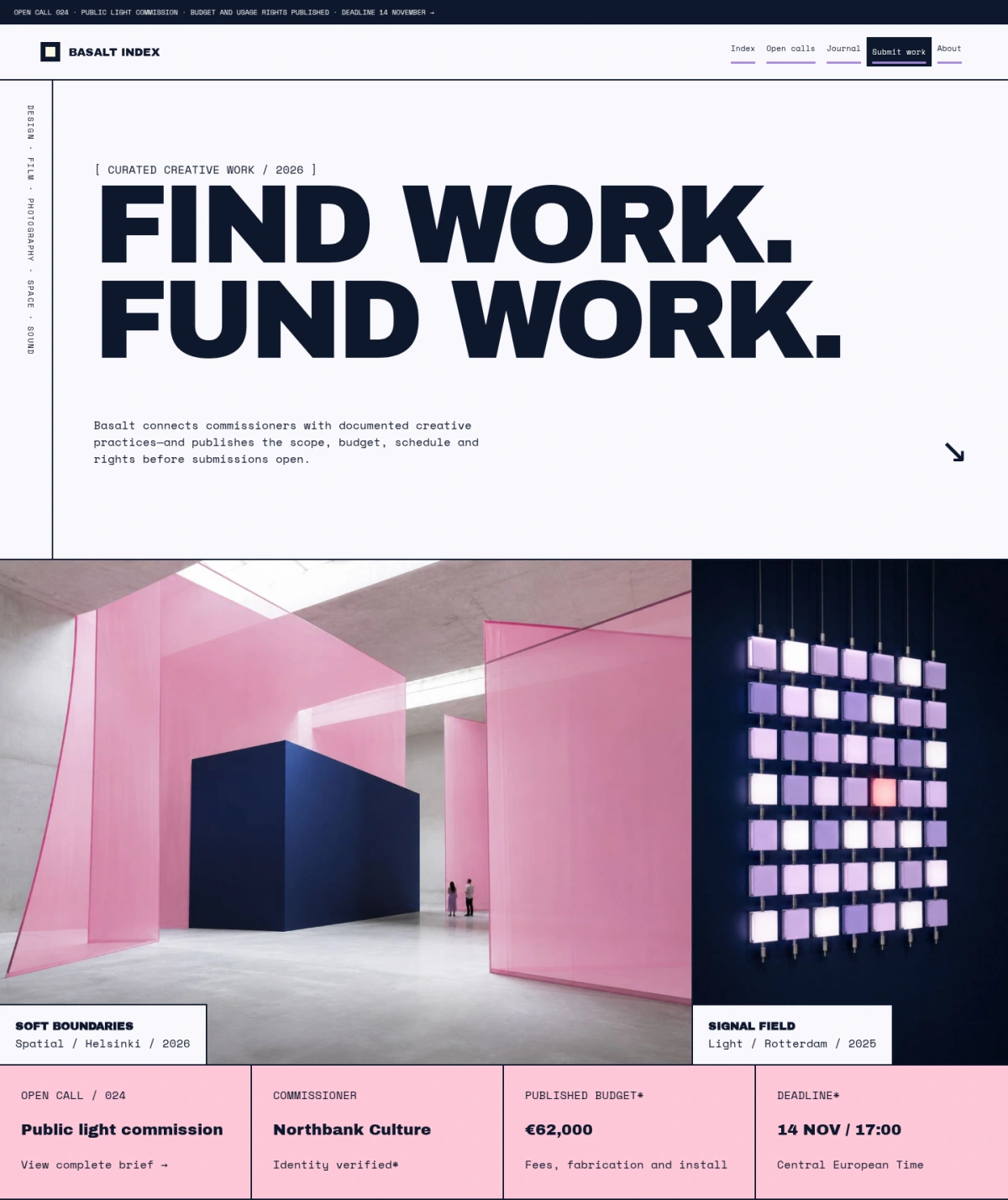
A brutalist creative index portal template for project discovery, open calls, commission briefs, and searchable work
Basalt Creative Index is built as a commissioning portal rather than a conventional studio portfolio. A vertical discipline rail frames the oversized proposition, an asymmetric two-work mosaic supports immediate discovery, and a four-part open-call strip publishes scope-critical facts before the searchable project table. A dark commission-quality checklist, editorial journal, and submission CTA complete the route. Happy Hues Palette 7 provides pale editorial surfaces, deep navy structure, pink call notices, lavender indexing fields, and a restrained purple highlight. Archivo Black and Space Mono create a deliberately brutalist but usable archive language, while the square logo and repeated keylines form the signature system.
Choose this template for a creative work index, commissioning portal, design association, cultural network, open-call platform, or curated project archive.
Replace the BASALT wordmark with a compact transparent logo and prepare simplified light, dark, and small-screen variants. Preserve the established spacing, typography, and color hierarchy so new content feels intentional rather than appended. Keep navigation labels concrete and organize them around the decisions visitors need to make.
Rewrite the opening proposition for a specific audience, problem, and outcome. Avoid broad superiority claims, invented awards, unsupported statistics, and promises the organization cannot consistently deliver. Projects need creator, collaborators, client where permitted, discipline, location, year, credits, rights holder, and case-study context. Explain editorial selection and label sponsored placement. Open calls require commissioning organization, deliverables, eligibility, budget, schedule, deadline, usage rights, and status. Reject speculative requests for unpaid finished concepts and provide reporting tools.
Profile ownership and identity verification should be clear even when profiles are not the dominant layout. Search filters need a controlled taxonomy and should not generate unlimited indexable URLs. Obtain rights for all portfolio imagery and video. Treat every photograph, illustration, diagram, icon, and interface example as replaceable content.
Use authentic assets with documented commercial rights and accurate alternative text. Keep important headings, prices, dates, status labels, controls, and actions outside photographs. When people are identifiable, obtain appropriate permission and represent the real audience without tokenism. Do not use generated imagery to imply facilities, staff, products, certifications, customers, or operating capacity that do not exist. Build repeated modules from structured fields rather than copying decorative blocks. Each destination page should have a clear owner, purpose, update schedule, and next action.
Display dates, prices, availability, locations, qualifications, measurements, and service conditions only when they are current and supportable. Explain methodology behind ratings, performance figures, comparisons, environmental claims, and outcome statistics. Archive or label superseded information rather than silently leaving it online.
Forms should request only information needed for the stated next step, identify who receives the submission, explain response timing, and show privacy context before submission. Sensitive files or personal information should move through an authenticated secure workflow rather than ordinary email or a public form.
For SEO, create substantial landing pages for meaningful services, subjects, locations, products, or resources. Give each page a unique title, description, canonical URL, logical heading structure, descriptive image alternative text, and useful internal links. Use structured data only when the visible page contains the same accurate information. Avoid mass-producing thin pages for every filter combination.
If the site is multilingual, localize terminology, dates, currencies, units, support expectations, and legal information instead of translating navigation alone. Optimize images into responsive WebP or AVIF variants with intrinsic dimensions and sensible crops.
On mobile, reflow tables, timelines, filters, comparison rows, maps, forms, and image groups without horizontal overflow. Maintain comfortable touch targets, visible keyboard focus, sufficient contrast, meaningful control labels, and reduced-motion support. Do not hide essential information behind hover. Optional analytics, advertising, chat, video, and third-party embeds must remain disabled until consent where required, with an accessible way to change preferences later.
Before launch, replace every fictional name, date, metric, image, testimonial, price, and status; verify claims, permissions, links, metadata, and legal disclosures; test navigation, search, filters, forms, notifications, error states, keyboard access, screen-reader labels, responsive layouts, performance, and consent; and add relevant privacy, terms, accessibility, contact, and operational policy pages. Establish a correction workflow so staff can update or withdraw material information quickly.
With accurate content and disciplined maintenance, the template can turn its visual system into a credible working a creative work index, commissioning portal, design association, cultural network, open-call platform, or curated project archive rather than a static design demonstration.