Cobalt Security Desk
An operational cybersecurity portal template with secure incident reporting, live status, advisories, and response playbooks
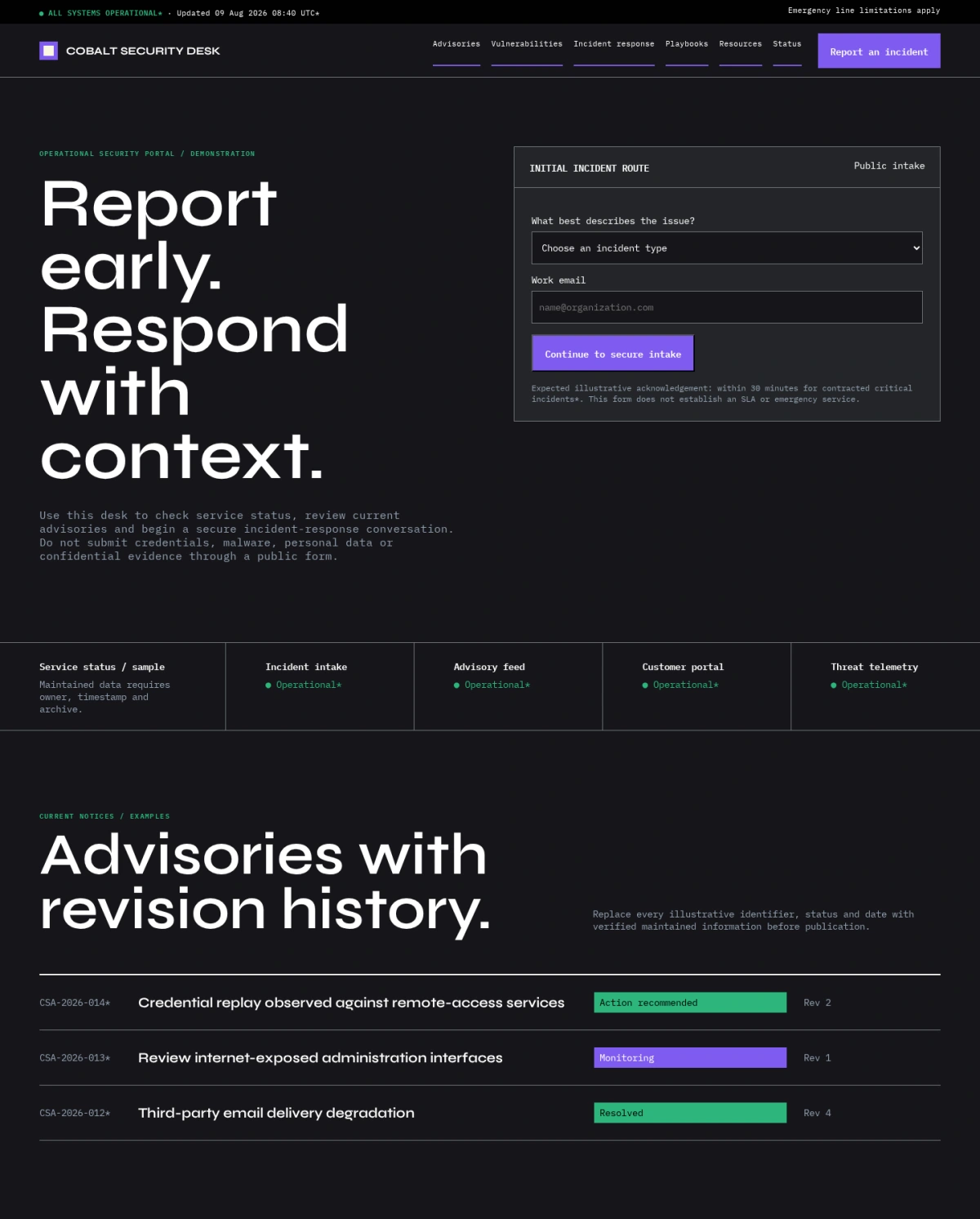
An operational cybersecurity portal template with secure incident reporting, live status, advisories, and response playbooks
Cobalt Security Desk is structured as a working security operations portal rather than a futuristic marketing poster. A guarded public incident route and timestamped service-status matrix lead into revision-aware advisories, methodology-based vulnerability severity, a response sequence, preparation playbooks, entity-scoped trust evidence, and verified emergency routes. The square ring becomes a compact dense-header mark and repeated state frame. Happy Hues Palette 4 supplies black and charcoal operational surfaces, white critical text, muted blue-gray context, violet actions, and green redundant operational states. Syne and IBM Plex Mono create strong technical hierarchy while preserving Bootstrap-compatible tables and panels.
Choose this template for a managed security provider, incident-response team, computer emergency response organization, security advisory service, internal security portal, or technology company with public operational notices.
Replace the Cobalt identity with a transparent logo and prepare a compact mark for dense headers. Preserve the shared container geometry, aligned table columns, consistent status colors, stable spacing, and clear hierarchy. The dark interface must remain readable rather than decorative: test every text, border, status, link, and focus color for sufficient contrast. Make the incident-reporting action prominent, but never collect confidential evidence, credentials, personal data, or malware samples in an ordinary public form. Use an authenticated encrypted workflow for sensitive submissions and state who receives the report, expected acknowledgement time, escalation route, retention policy, and emergency limitations.
Keep severity definitions visible and avoid implying guaranteed response times unless service agreements support them. Status rows and advisories must come from maintained structured data with an owner, timestamp, timezone, update cadence, and archive policy. Clearly distinguish operational incidents, planned maintenance, investigations, resolved events, general advisories, and third-party issues. Vulnerability records should include a verified identifier where available, affected products and versions, severity methodology, publication and revision dates, remediation or mitigation, references, and disclosure credits.
Do not copy vendor guidance without permission or present unverified exploit claims as fact. Sector playbooks should provide practical high-level preparation while directing users to qualified assistance; avoid publishing details that materially increase attack risk. Compliance badges, certifications, audit claims, encryption statements, availability metrics, customer counts, and partner logos must be accurate for the named legal entity and current scope. Never invent live data, clients, incident volumes, endorsements, or security outcomes. Keep all operational text, state labels, dates, controls, and contact routes as editable HTML rather than imagery.
Icons should reinforce labels, not replace them. Graphs need text summaries, tables need proper headings, and color-coded states need redundant text or symbols.
For SEO, publish substantial advisory, vulnerability, service, and resource pages with unique titles, descriptions, canonical URLs, meaningful headings, update dates, and internal links. Prevent filter parameters and transient status views from creating thin duplicate pages.
If multilingual, localize terminology, timestamps, emergency routes, regulatory notices, and support expectations.
On mobile, convert wide matrices into labeled stacked records or controlled accessible scrolling, keep critical actions visible, and prevent dense tables from shrinking into unreadable text. Support keyboards, screen readers, visible focus, reduced motion, large touch targets, and live-region announcements for meaningful status changes. Optional analytics, chat, video, and third-party widgets should not load before valid consent where required, and security telemetry should be documented separately from marketing tracking.
Before launch, replace all fictional services, incidents, identifiers, metrics, contacts, certifications, and timestamps; test secure intake, validation, rate limits, abuse handling, status updates, advisories, filters, links, keyboard access, mobile layouts, failure modes, privacy choices, and performance. Add reviewed privacy, terms, acceptable-use, vulnerability-disclosure, incident-handling, accessibility, data-retention, and legal-contact pages. Define on-call ownership and a correction process so urgent information can be updated without redesigning the page, with named deputies, escalation paths, review evidence, and tested out-of-hours publishing access.