NOMU
A searchable global professional-services portal for matching businesses with vetted experts
A searchable global professional-services portal for matching businesses with vetted experts
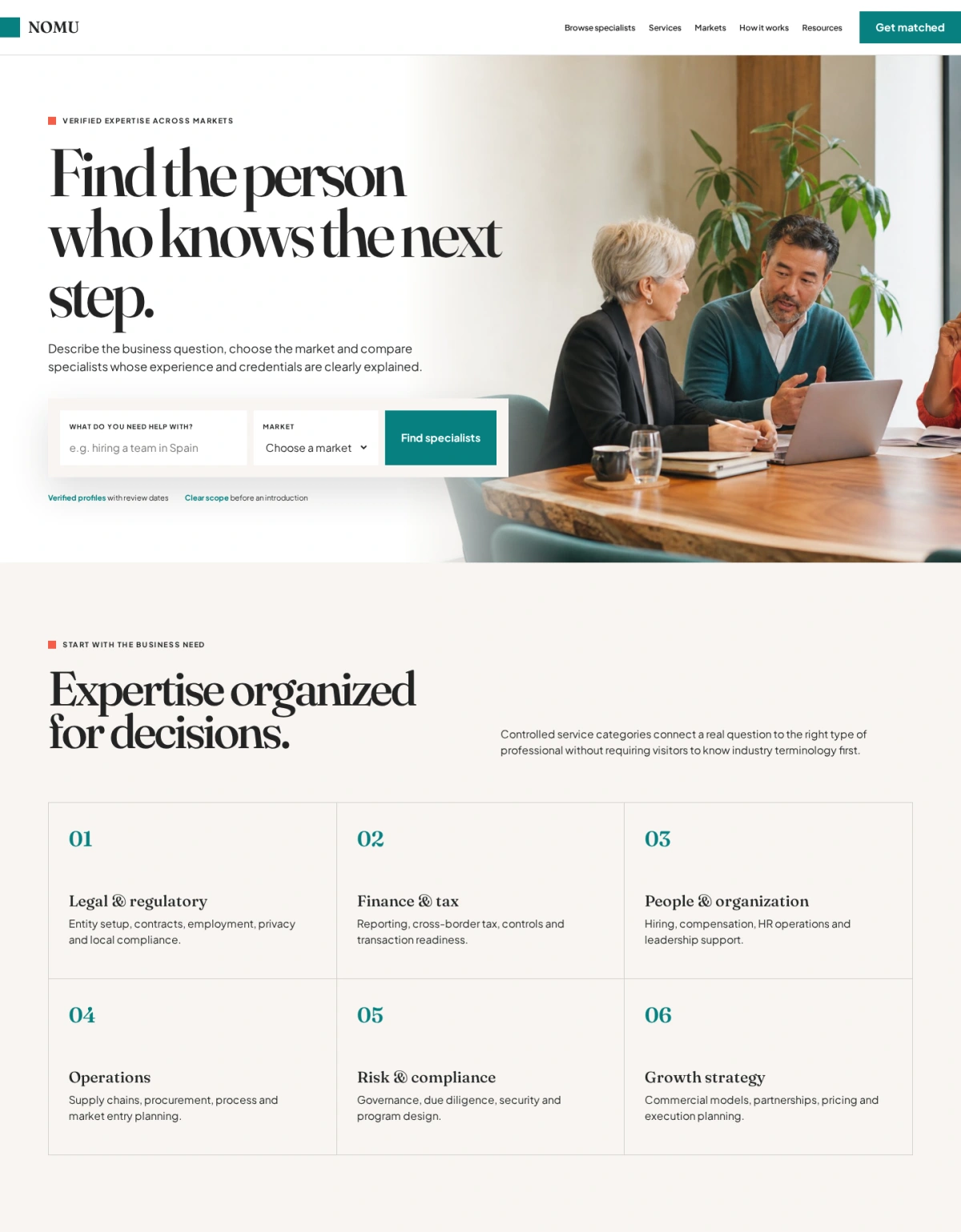
NOMU replaces the conventional consulting-company hero with a search-first marketplace experience. A candid collaboration image establishes human trust, a structured service map translates business needs, verified expert profiles enable comparison, and a transparent four-step journey explains the operational match. The entire visual system uses Happy Hues Palette 8: warm paper and white create an editorial directory surface, charcoal anchors readable content, teal carries actions and verification, coral identifies steps and important signals, and soft blush separates supporting modules. A single solid teal square forms the intentionally simplified logo without dots or secondary shapes.
Choose this template for a directory, marketplace, association, membership network, referral service, or multi-practice professional organization where visitors need to find the right person rather than read a general company presentation. Suitable applications include legal and accounting networks, fractional executive directories, HR advisory platforms, compliance marketplaces, business mentor communities, healthcare professional directories, and international consulting alliances. The strongest implementation has enough verified profiles and service categories to make search genuinely useful.
If only a handful of professionals are available, simplify the portal structure instead of presenting inflated network statistics.
Replace the NOMU wordmark with a restrained transparent logo. The warm editorial design works best with a horizontal mark and a simple symbol that can also appear on profile badges. Build the information architecture before customizing visuals. Define a controlled service taxonomy, locations, languages, industries served, delivery methods, credentials, availability, and fee models. Avoid free-form tags that create several labels for the same specialty. The hero search should accept natural customer needs but resolve them into validated categories or assisted matching. Provide useful suggestions, spelling tolerance, an empty-results state, and a clear path to human help.
Do not promise an expert match unless an operational workflow exists behind the form. Expert profiles are the core content. Each should include a professional portrait, full name, verified specialty, jurisdiction or location, languages, experience summary, credentials, service format, typical client type, and an understandable contact or booking action. Obtain permission for every portrait and biographical claim. Use consistent photographic cropping and neutral lighting, but allow enough variation that the directory feels human rather than synthetic. Clearly explain what vetted means, who performs verification, how often credentials are reviewed, and whether the platform recommends, ranks, or merely lists professionals.
If reviews or ratings are added, publish moderation and dispute policies. Service pages should describe common problems, expected deliverables, preparation steps, typical engagement patterns, and boundaries. Avoid giving regulated legal, medical, tax, or financial advice in generic marketing copy. Include jurisdiction notices and encourage users to confirm that a professional is qualified for their location. The geographic section should reflect actual coverage; replace fictional country and expert totals with verified values. Explain remote versus in-person service and time-zone availability. The How It Works journey should match the real operational sequence from request to shortlist, profile review, scheduling, payment if applicable, and follow-up.
Set realistic response expectations. Use the resource library to answer recurring questions and attract organic search traffic, but have regulated content reviewed by appropriately qualified contributors.
For SEO, create indexable expert and service pages with unique titles, descriptions, canonical URLs, structured professional or organization data when accurate, and strong internal links. Manage filter URLs carefully so combinations do not create thousands of duplicate pages. Protect personal information, add explicit consent for inquiry sharing, secure uploaded documents, and state retention practices. If analytics or advertising are optional, do not load them before consent.
On mobile, filters should open in an accessible panel, profile cards must remain scannable, and primary contact controls should be easy to reach without becoming intrusive.
Before launch, test search relevance, profile accuracy, location filters, form routing, email notifications, accessibility, abuse reporting, privacy requests, and the expert onboarding flow. With reliable operations behind it, this template can turn a fragmented professional network into a clear, trustworthy discovery experience for global small businesses.