Halcyon Logistics
A connected global logistics brand template organized around routes, handoffs, freight modes, and network evidence
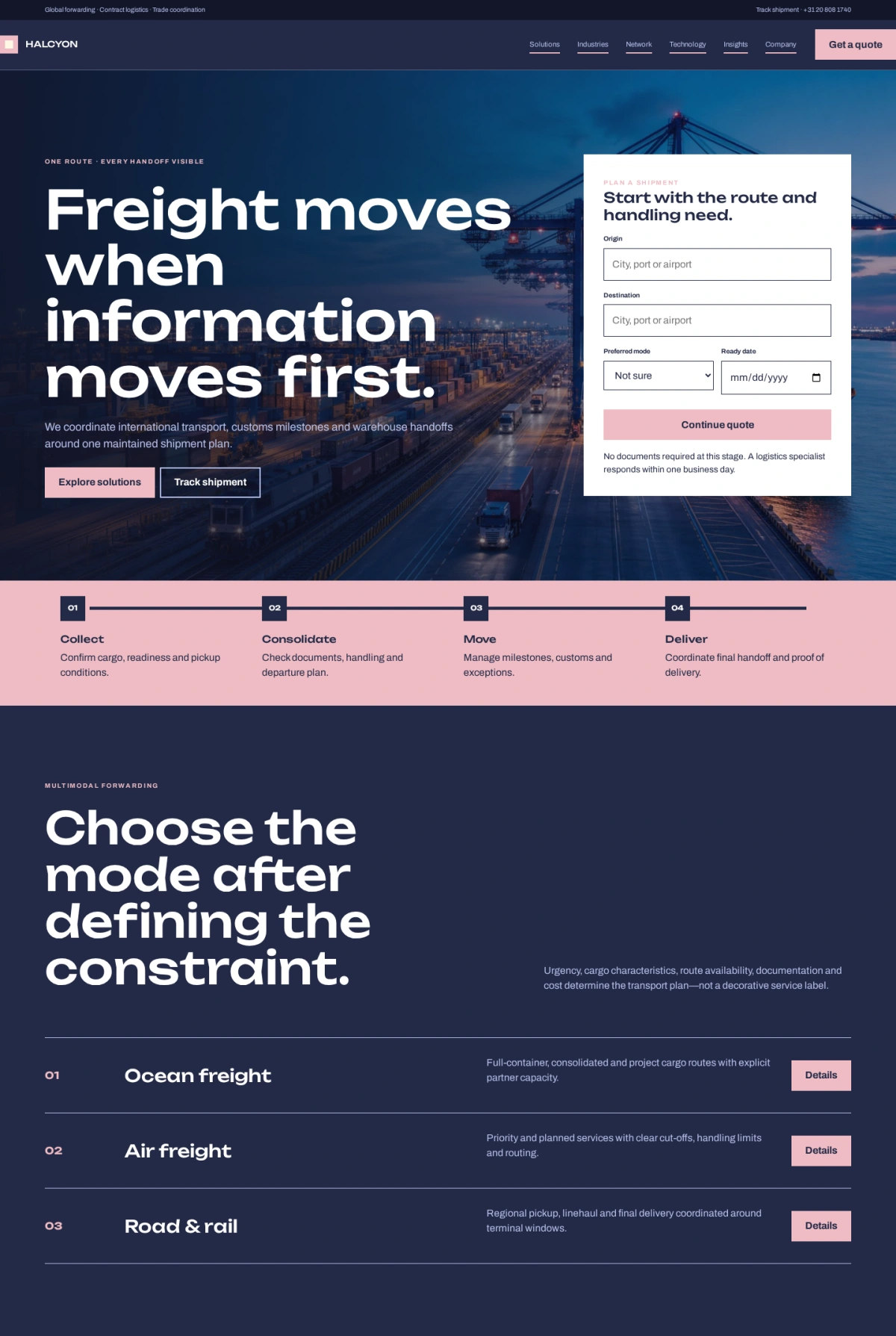
A connected global logistics brand template organized around routes, handoffs, freight modes, and network evidence
Halcyon makes the route itself the page structure. A port-led opening combines a shipment form with a continuous four-stage handoff strip; freight modes use horizontal comparison rows, while an HTML route diagram, maintained network evidence, a warehouse handoff story, industry requirement rows, and operational insights reinforce end-to-end coordination without resembling a dashboard. Happy Hues Palette 12 supplies deep indigo foundations, white headings, lavender supporting text, pale-pink route nodes and actions, and a restrained dusty-rose secondary tone. A single outlined square acts as the compact logistics mark, paired with Unbounded and Archivo for a precise global identity.
Choose this template for a freight forwarder, third-party logistics provider, multimodal carrier, contract logistics company, customs service, supply-chain technology brand, or international transportation business. It is suitable when buyers need to understand geographic coverage, operational handoffs, freight modes, specialist industries, and quotation requirements.
Replace the HALCYON mark with a transparent horizontal logo and retain a compact symbol for mobile, route markers, documents, and social images. Keep signal orange reserved for actions, active modes, and key nodes so operational status colors remain meaningful. The opening route map must be generated from real coverage information or clearly described as illustrative. Do not imply direct routes, owned facilities, countries served, or service frequency when capacity depends on partners. Shipment origin and destination fields should provide accessible suggestions, validation, empty states, and support guidance.
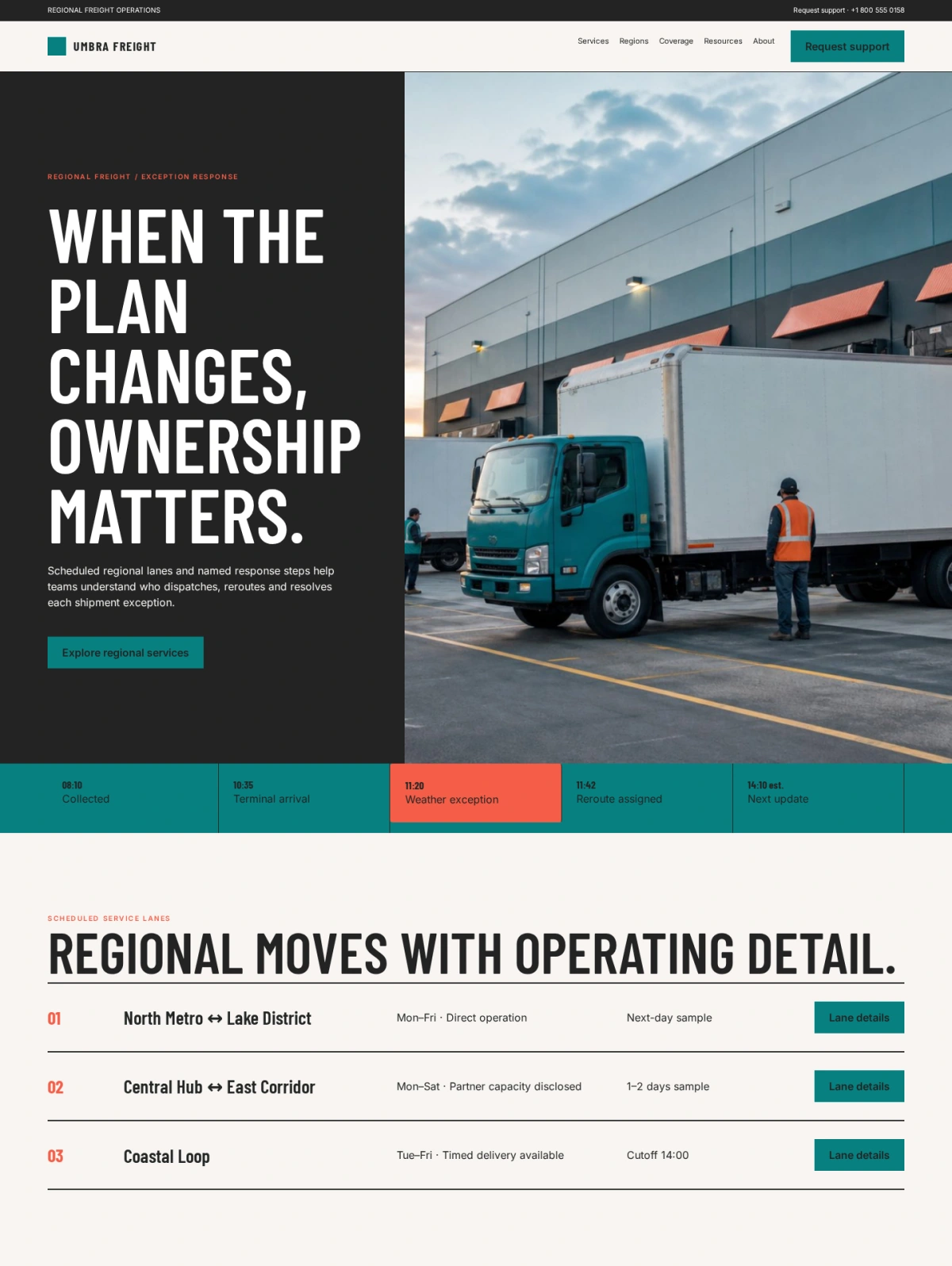
If tracking exists, route it to an authenticated operational system rather than exposing shipment data publicly. The Collect, Consolidate, Move, and Deliver sequence should reflect actual handoffs, customs responsibilities, documentation, exception management, milestone events, and proof of delivery. Explain which milestones are estimates and how customers receive disruption alerts. Freight imagery must represent equipment and modes the company actually supports. Freight-mode tabs need substantial destination pages describing service regions, consolidation options, transit expectations, size and weight limits, equipment, documentation, exclusions, and support.
Distinguish owned operations from partner capacity. Network metrics such as countries, ports, hubs, shipments, visibility, and on-time performance require a defined reporting period, population, and methodology. Avoid decorative figures that cannot be audited. Industry solution rows should address genuine differences in temperature control, dangerous goods, security, chain of custody, compliance, seasonality, payload, or delivery speed. Do not repeat generic copy beneath different industry labels. Customer stories should identify the challenge, route design, operational constraints, measurement period, and verified result, with client permission or transparent anonymization.
Replace fictional speed, visibility, damage, and cost figures with evidence and disclose important conditions. Quote forms should collect origin, destination, goods, dimensions, weight, mode, timing, handling requirements, and contact details without requesting sensitive documents during the first step. State response expectations and identify who receives the request.
For SEO, create useful service, lane, industry, location, and case-study pages only where the company can provide substantial content. Use unique metadata, canonical URLs, descriptive alternative text, internal links, and Organization or Service structured data when accurate. Avoid mass-generating thin route pages.
If multilingual, localize trade terminology, currencies, units, customs context, office details, and legal notices. Provide nonvisual explanations for maps and route diagrams. Optimize freight photography with responsive formats and intrinsic dimensions.
On mobile, shipment fields, route stages, mode tabs, data bands, solution rows, and story columns must remain keyboard and touch accessible without horizontal overflow. Protect quotation, tracking, commercial, and customer data with appropriate authentication, retention, and access logging.
Before launch, verify every route, partner, mode, office, metric, certification, testimonial, and environmental claim; test quotation routing, tracking links, notifications, language switching, consent, and accessibility; and add privacy, terms, cargo exclusions, dangerous-goods, claims, and compliance notices.
With accurate operational data, this template can make a complex logistics network feel understandable, connected, and dependable.