Umbra Freight
A responsive regional freight brand template organized around shipment status, service lanes, and exception resolution
A responsive regional freight brand template organized around shipment status, service lanes, and exception resolution
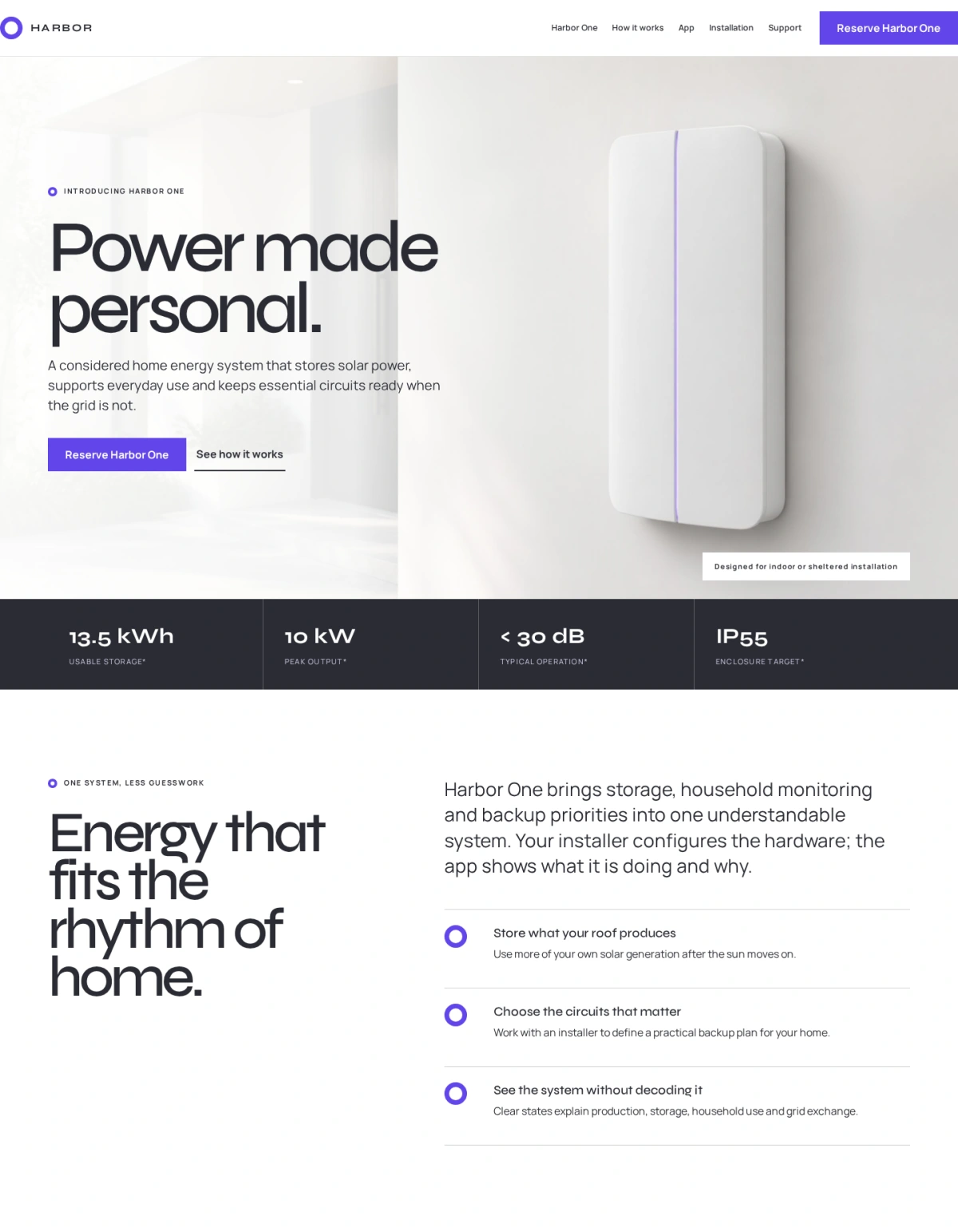
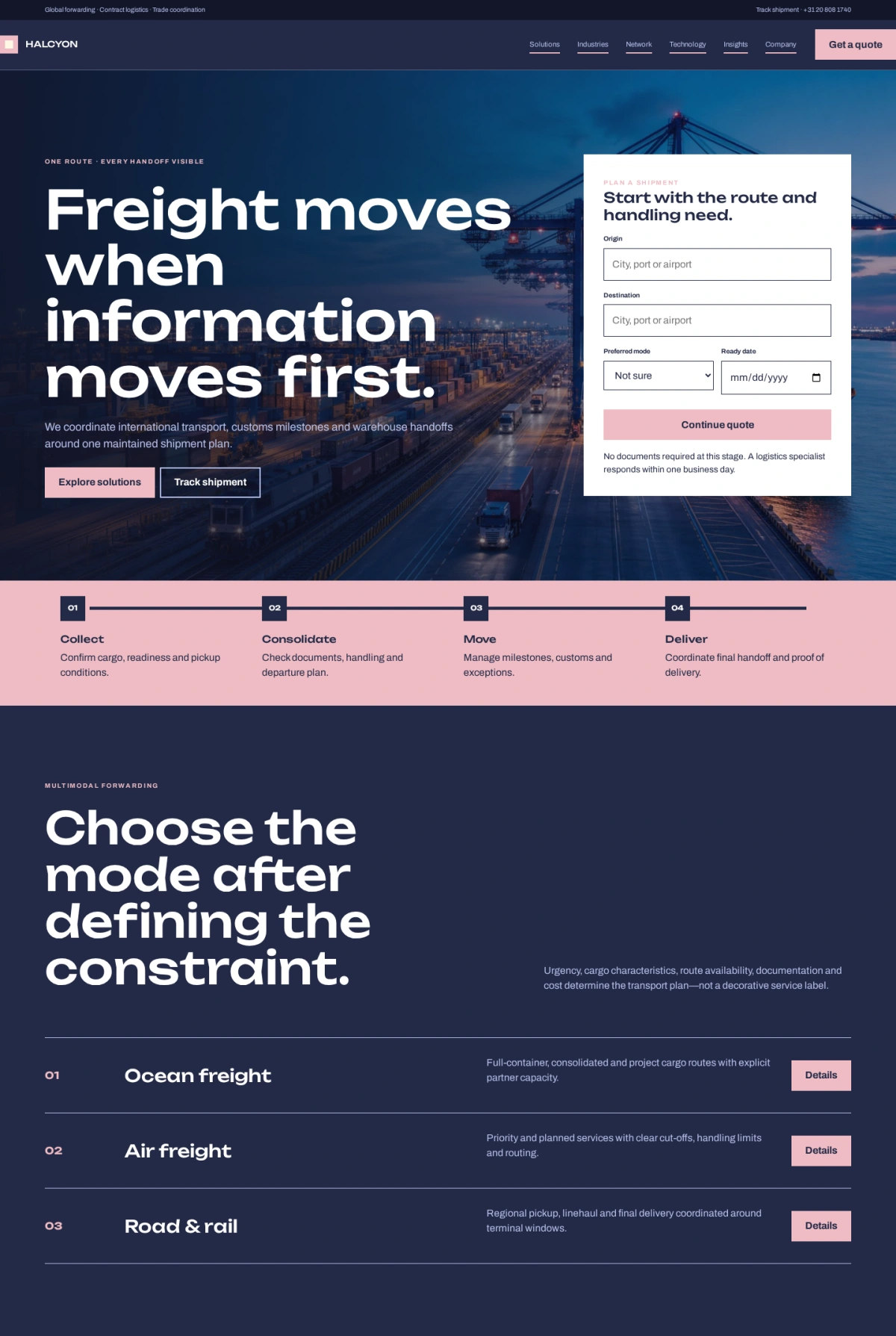
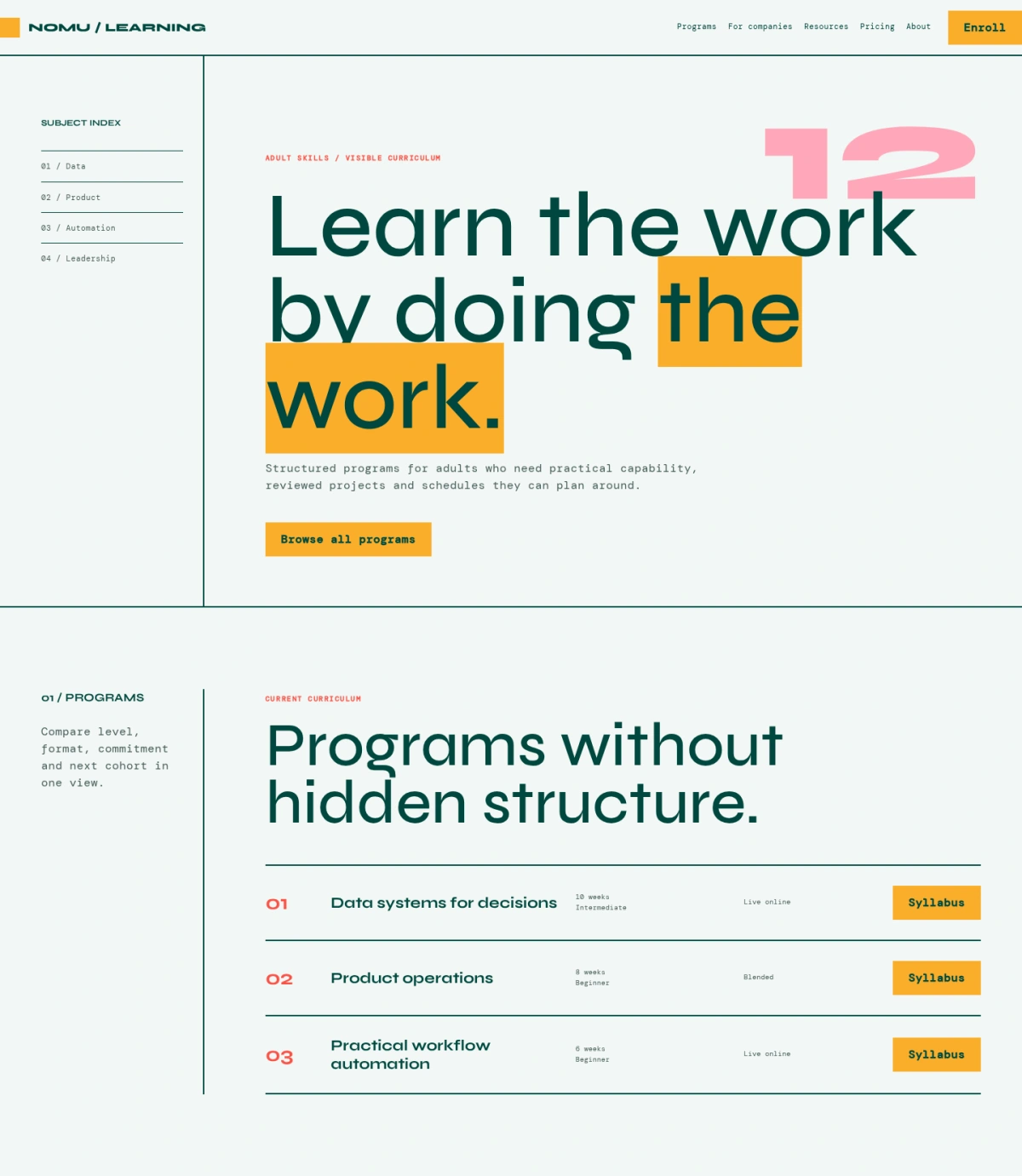
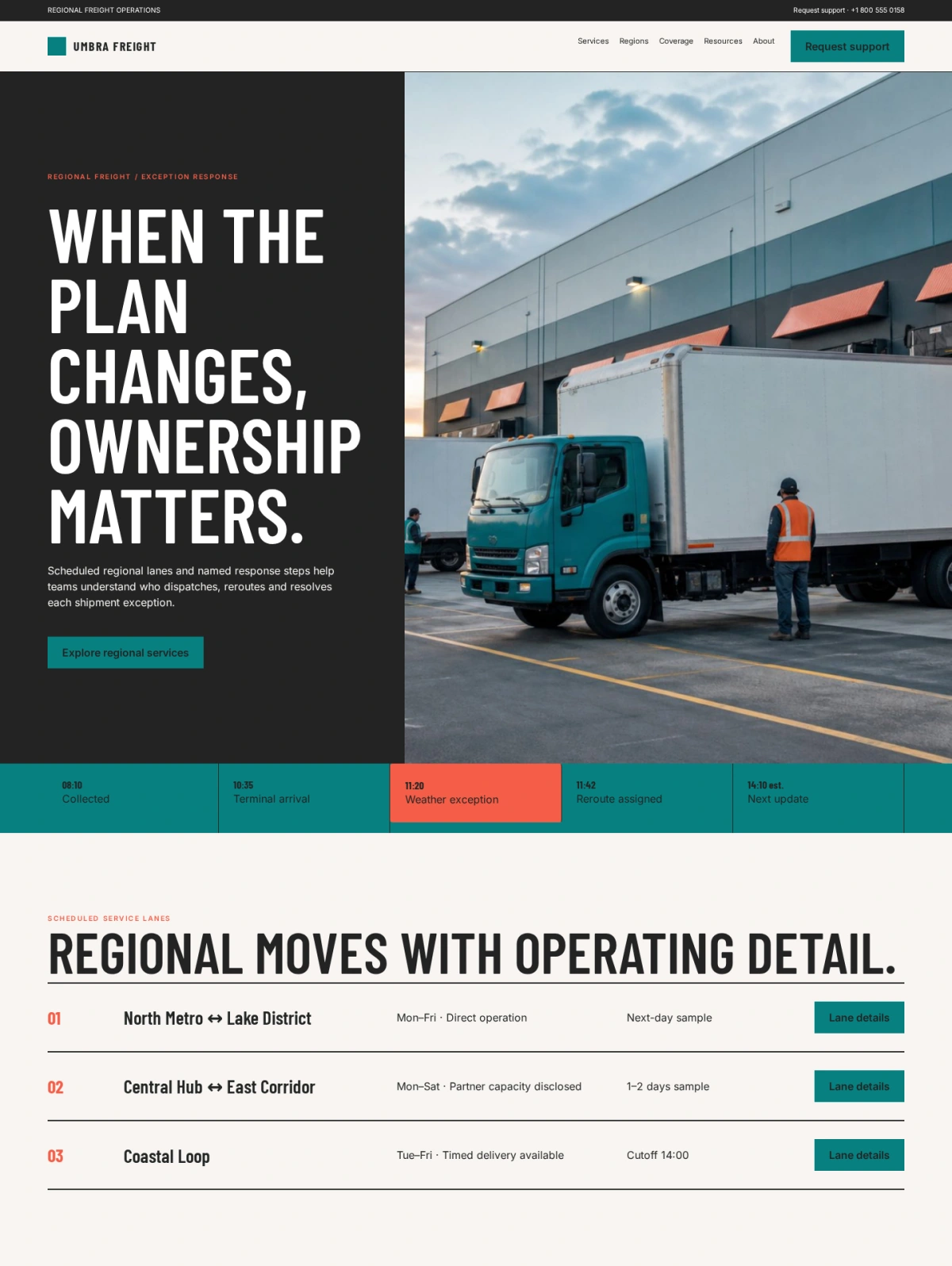
Umbra Freight builds its proposition around what happens when a regional shipment changes. A documentary terminal opening, timestamped milestone ribbon, detailed regional lane rows, three-part exception-response sequence, capability matrix, and operations-proof checklist communicate service reliability without repeating a global route-map narrative. Happy Hues Palette 8 supplies warm paper, utilitarian charcoal, teal status surfaces and the solid-square logo, with coral reserved for exceptions. Barlow Condensed and Inter reinforce the operational hierarchy.
Choose this template for a regional freight carrier, third-party logistics provider, expedited service, distribution network, or transportation support company.
Replace the UMBRA wordmark with a compact transparent logo and prepare simplified light, dark, and small-screen variants. Preserve the established spacing, typography, and color hierarchy so new content feels intentional rather than appended. Keep navigation labels concrete and organize them around the decisions visitors need to make.
Rewrite the opening proposition for a specific audience, problem, and outcome. Avoid broad superiority claims, invented awards, unsupported statistics, and promises the organization cannot consistently deliver. Shipment examples must be clearly fictional or sourced from secure live systems; never expose customer references publicly. Status milestones, delays, estimates, and exception flags need consistent definitions and timestamps. Regional lanes should distinguish direct operations, contracted capacity, service frequency, transit estimates, exclusions, and cutoff times. Explain Dispatch, Reroute, and Resolve as real operational responsibilities with response expectations.
Coverage tables must be maintained from actual capabilities. Support forms should collect shipment identifiers securely and route urgent safety issues to appropriate channels. Treat every photograph, illustration, diagram, icon, and interface example as replaceable content.
Use authentic assets with documented commercial rights and accurate alternative text. Keep important headings, prices, dates, status labels, controls, and actions outside photographs. When people are identifiable, obtain appropriate permission and represent the real audience without tokenism. Do not use generated imagery to imply facilities, staff, products, certifications, customers, or operating capacity that do not exist. Build repeated modules from structured fields rather than copying decorative blocks. Each destination page should have a clear owner, purpose, update schedule, and next action.
Display dates, prices, availability, locations, qualifications, measurements, and service conditions only when they are current and supportable. Explain methodology behind ratings, performance figures, comparisons, environmental claims, and outcome statistics. Archive or label superseded information rather than silently leaving it online.
Forms should request only information needed for the stated next step, identify who receives the submission, explain response timing, and show privacy context before submission. Sensitive files or personal information should move through an authenticated secure workflow rather than ordinary email or a public form.
For SEO, create substantial landing pages for meaningful services, subjects, locations, products, or resources. Give each page a unique title, description, canonical URL, logical heading structure, descriptive image alternative text, and useful internal links. Use structured data only when the visible page contains the same accurate information. Avoid mass-producing thin pages for every filter combination.
If the site is multilingual, localize terminology, dates, currencies, units, support expectations, and legal information instead of translating navigation alone. Optimize images into responsive WebP or AVIF variants with intrinsic dimensions and sensible crops.
On mobile, reflow tables, timelines, filters, comparison rows, maps, forms, and image groups without horizontal overflow. Maintain comfortable touch targets, visible keyboard focus, sufficient contrast, meaningful control labels, and reduced-motion support. Do not hide essential information behind hover. Optional analytics, advertising, chat, video, and third-party embeds must remain disabled until consent where required, with an accessible way to change preferences later.
Before launch, replace every fictional name, date, metric, image, testimonial, price, and status; verify claims, permissions, links, metadata, and legal disclosures; test navigation, search, filters, forms, notifications, error states, keyboard access, screen-reader labels, responsive layouts, performance, and consent; and add relevant privacy, terms, accessibility, contact, and operational policy pages. Establish a correction workflow so staff can update or withdraw material information quickly.
With accurate content and disciplined maintenance, the template can turn its visual system into a credible working a regional freight carrier, third-party logistics provider, expedited service, distribution network, or transportation support company rather than a static design demonstration.