Meridian Trade Review
An editorial trade intelligence and business publication template for globally minded readers
An editorial trade intelligence and business publication template for globally minded readers
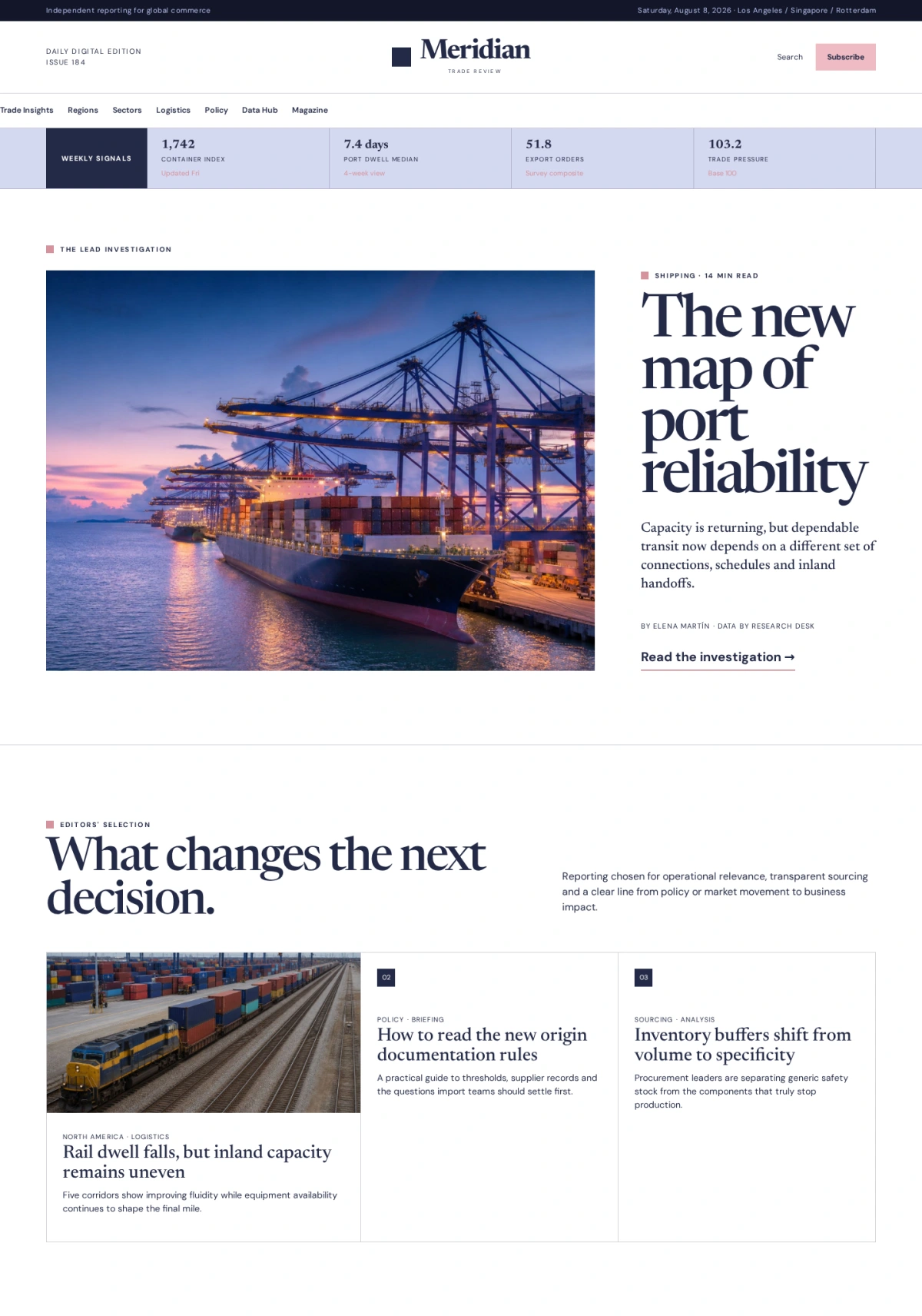
Meridian Trade Review combines the authority of an international business journal with the immediacy of a modern digital publication. An asymmetric lead investigation, market-signal strip, editorial selection, regional desk, and research-method section create a rich reading environment without resembling a corporate brochure or dashboard. The full visual system comes from Happy Hues Palette 12: deep indigo provides editorial authority, paper white preserves reading clarity, periwinkle supports secondary information, blush marks subscriptions, and muted rose identifies data signals. A single solid square is the deliberately simplified logo and recurring section marker.
Use this template for a publication, research group, trade association, logistics knowledge center, export advisory firm, or company that wins customers through authoritative content. It works best when the website has a steady editorial program and several meaningful ways to organize information, such as region, industry, topic, format, or market. The visual hierarchy is intentionally closer to a global business magazine than a conventional blog. Select it when readers should see a clear difference between a lead investigation, a timely briefing, a data update, and evergreen educational material.
Begin by replacing the MERIDIAN masthead with a simple wordmark that remains legible at small sizes. Serif typography communicates editorial authority, but the supporting interface font should stay highly readable for figures, labels, navigation, and mobile screens. Define a small color system before adding content: one primary institutional color, one link color, positive and negative data colors, and a restrained accent for breaking or featured stories. Do not introduce a new color for every content category. The lead story should represent the strongest current editorial contribution, not merely the newest post.
Use a high-quality documentary image with a clear source and usage license, a direct headline, a concise summary, and a visible reading action. The market signals strip may display freight rates, currency indicators, commodity prices, shipping indexes, or internal research metrics, but only if the data has a reliable source, update schedule, timestamp, and explanation. If live data is unavailable, replace the strip with curated weekly indicators or key findings rather than publishing decorative numbers. Build a taxonomy before importing articles. Recommended dimensions include regions, sectors, topics, and content formats.
Avoid placing the same concept in several competing category systems. Each article should have a native URL, meaningful summary, author, publication date, update date when relevant, hero image, source references, and related reading. Long reports benefit from an automatically generated table of contents and clear section headings. Regional modules should contain genuinely local content rather than translated global summaries. If the publication supports multiple languages, create separate language taxonomies, localized metadata, and equivalent navigation for every market. Do not point all alternate-language links back to the home page.
The newsletter panel should explain frequency, subject matter, sender identity, and privacy treatment before requesting an email address. Use double opt-in where required and never load optional marketing trackers before consent. For commercial publications, distinguish editorial analysis from sponsored material and label partnerships clearly. Search pages should support title and summary discovery, while filters should help users narrow by region or topic without creating duplicate indexable URLs.
For SEO, write unique metadata, use Article structured data where supported, maintain canonical URLs, publish an XML sitemap, and create internal links between related reports. Optimize every image locally and record its source.
On mobile, the lead story should retain its headline priority, tables must scroll or reformat safely, and market data should not become unreadably small. Before release, review all claims, remove placeholder indicators, test subscription handling, verify author biographies, and confirm that archived content remains accessible. With a disciplined publishing calendar and credible sourcing, this template can become a durable acquisition channel for organizations whose expertise is their most valuable product.