VALE MUSEUM ARCHIVE
A museum collections portal template with object search, chronology, curatorial essay, researcher tools, digitization, and image rights
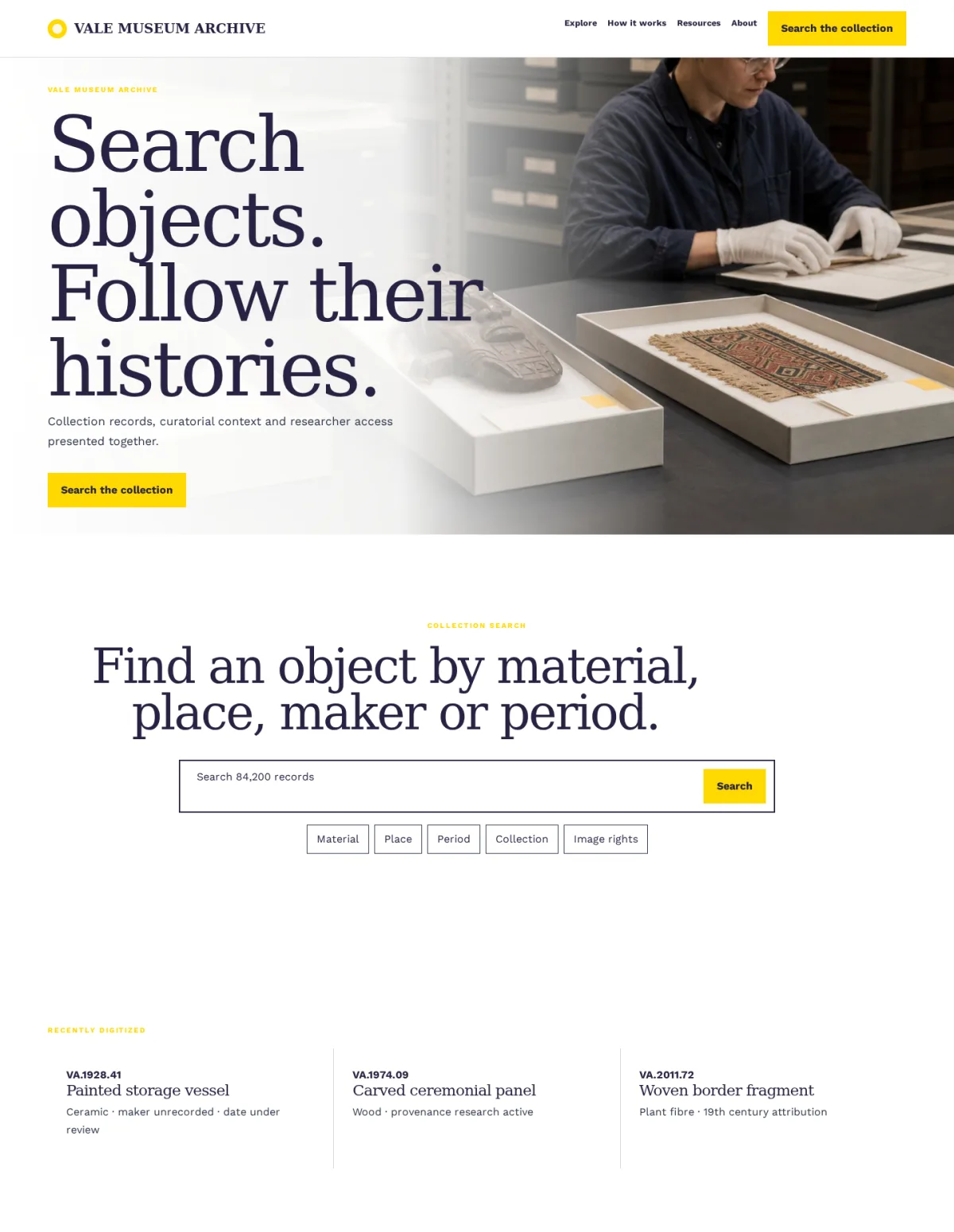
A museum collections portal template with object search, chronology, curatorial essay, researcher tools, digitization, and image rights
Vale begins with collection search and aligned object records, then adds a chronological exploration rail, curatorial essay, collection index, researcher access, digitization progress, exhibitions, and rights guidance. Objects remain inside archival frames with metadata rather than becoming floating decorative art.
Choose this template for a museum, archive, gallery collection, heritage institution, university special collection, or digital humanities portal.
Replace the Vale identity with a transparent institutional mark and compact variant for object records and mobile navigation. Preserve the shared container edges, consistent object ratios, metadata hierarchy, restrained rules, and generous but efficient spacing. Collection search should query maintained structured records and offer useful filters such as era, material, region, maker, department, object type, and availability. Every object record should include a stable accession identifier, preferred title, object type, maker or culture using reviewed terminology, date or date range with uncertainty, materials, dimensions and units, place, department, credit line, rights status, image credit, provenance summary, exhibition and bibliography references, record update date, and responsible curator or data source.
Distinguish catalogued fact, attribution, interpretation, translation, and uncertainty. Avoid presenting broad cultural labels, colonial-era terminology, or contested provenance without context and review. Timelines must handle approximate dates, overlapping periods, regional differences, and before-common-era notation accessibly. Curatorial essays need named authors, publication dates, sources, citations, image rights, and correction routes. Digitization counts should define what constitutes a record or image, the denominator, snapshot date, and exclusions. Researcher tools should explain reading-room access, appointments, handling, accessibility, reproduction, citation, data export, and restricted materials.
Rights and image requests need copyright or public-domain status, licensing terms, fees, permitted uses, attribution, turnaround, privacy, cultural restrictions, and contact. Never invent objects, accession numbers, provenance, cultures, rights, exhibitions, donors, dates, digitization metrics, or institutional claims. Replace all generated objects, portraits, maps, documents, and galleries with authoritative rights-cleared assets before launch. Generated artifacts must never be presented as collection holdings or evidence. Keep titles, metadata, dates, controls, rights, captions, and actions in HTML.
Alternative text should describe the object, view, material, form, and notable features while respecting cultural protocols.
Forms should collect only necessary inquiry data and use secure workflows for unpublished provenance, donor records, researcher identity, restricted collections, and payments.
For SEO, create substantial object, collection, maker, culture, era, material, exhibition, essay, and research pages with unique titles, descriptions, canonical URLs, logical headings, citations, update dates, and internal links. Apply Museum, VisualArtwork, CreativeWork, ExhibitionEvent, Person, or Dataset structured data only when visible facts match. Prevent filters and alternate image views from producing duplicate pages.
If multilingual, localize metadata, names, dates, citations, cultural terminology, rights, and visitor information through qualified curatorial review.
On mobile, make filters accessible, stack object metadata, preserve image proportions, convert timelines to readable sequences, and avoid overflow. Maintain keyboard access, visible focus, strong contrast, large targets, skip links, screen-reader landmarks, reduced motion, and non-color states. Optional analytics, maps, video, audio, donations, and collection viewers should respect consent and rights.
Before launch, replace all fictional objects, metadata, images, exhibitions, dates, metrics, addresses, and claims; test search, filters, object records, timelines, image zoom, rights requests, appointments, downloads, keyboard use, screen readers, responsive layouts, performance, consent, and failures. Add reviewed privacy, terms, accessibility, collections, provenance, rights, cultural care, corrections, research access, donations, and contact pages, with curatorial, rights, data, accessibility, and content owners and formal review schedules.