QUILL TRANSLATION JOURNAL
A bilingual literary journal template with parallel text, annotations, issue contents, audio reading, contributors, and archive
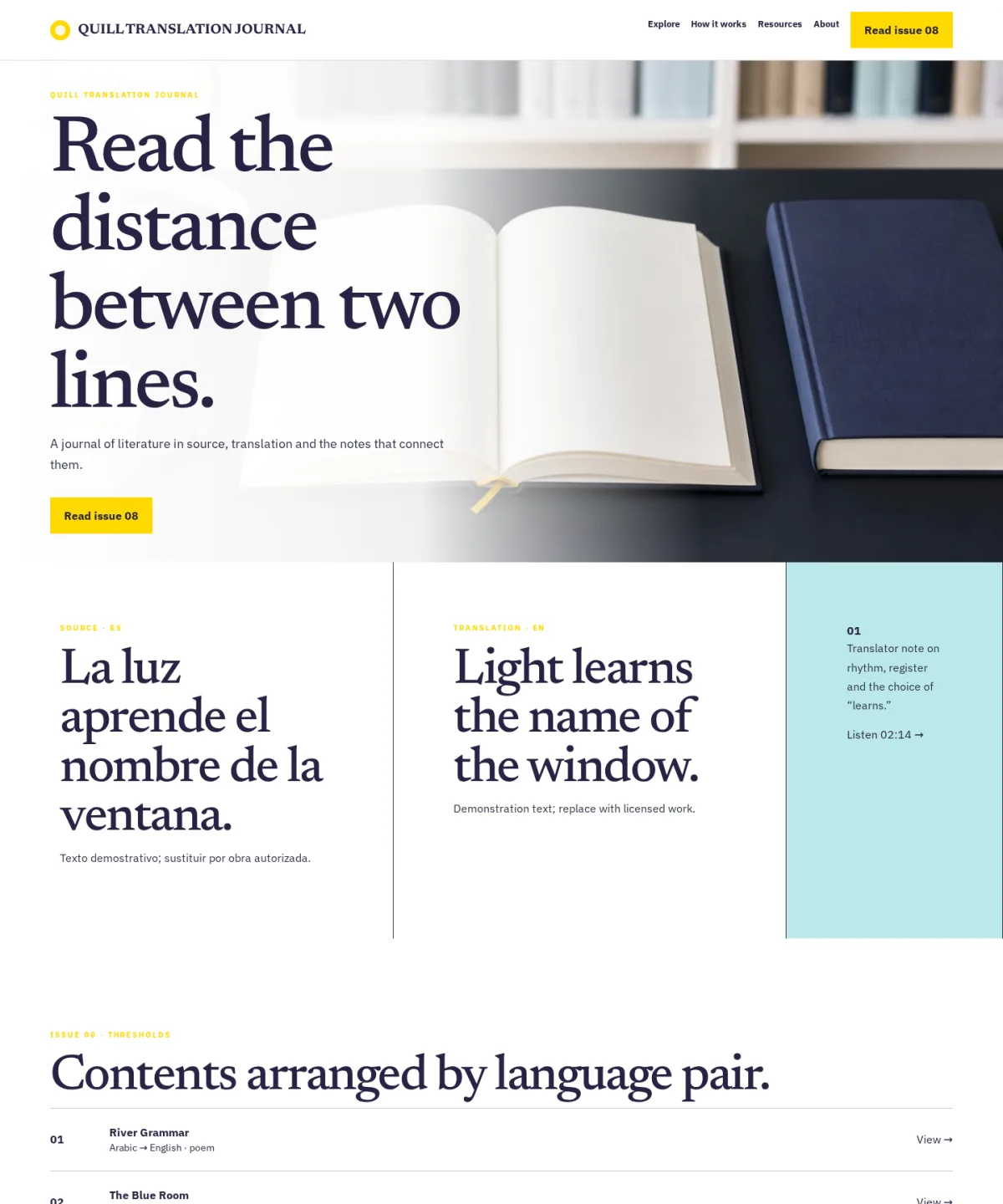
A bilingual literary journal template with parallel text, annotations, issue contents, audio reading, contributors, and archive
Quill builds its homepage around the act of translation: source and translated text sit in parallel columns beside annotations and author context. Issue contents, translator notes, poetry, region index, audio, contributors, archive, and submissions create a publication architecture unlike a conventional news grid.
Choose this template for a literary translation journal, bilingual magazine, cultural review, poetry publication, academic humanities project, or independent press.
Replace the Quill identity with a transparent masthead and compact mark for mobile and issue covers. Preserve the parallel column grid, shared baselines, annotation rail, generous margins, consistent rules, and comfortable reading width. Do not add paper textures or manuscript decoration that reduces clarity. Every publication record should include title, source-language title, author, translator, original language, target language, genre, issue, publication date, rights statement, credits, biography, and stable URL. Parallel text must be encoded as real selectable text with correct language attributes, reading order, line breaks, and typography; do not publish important prose only as an image.
Decide whether source and translation align by paragraph, stanza, sentence, or note, and provide a usable single-column mobile order. Annotations should identify their author, purpose, and relationship to the text. Obtain written publication and translation rights covering territories, formats, duration, archive, audio, promotion, and reuse. Clearly label public-domain material and verify both source-text and translation status. Do not assume permission from the availability of a text online. Contributor biographies, names, dates, affiliations, portraits, and cultural descriptions must be accurate and approved.
Avoid invented quotations, translations, authors, awards, citations, or historical claims. Replace all generated portraits and region graphics with licensed or authorized assets before launch. Never present model-generated translation as the work of a named translator. Keep titles, author names, notes, issue metadata, transcripts, and actions in HTML. Alternative text should describe portraits and visual material without inferring identity or ethnicity beyond supplied context. Audio readings need performer and rights credits, duration, transcript or synchronized text where practical, accessible controls, download policy, and hosting permission.
Submission guidance should state genres, languages, lengths, reading period, simultaneous-submission rules, payment, rights requested, response timing, accessibility, conflicts, privacy, and withdrawal procedure.
Forms should collect only necessary information and use secure storage for unpublished work and contributor data.
For SEO, create substantial issue, article, contributor, language, genre, archive, and editorial-policy pages with unique titles, descriptions, canonical URLs, logical headings, authors, translators, dates, citations, and internal links. Use Article, Person, CreativeWork, AudioObject, or Breadcrumb structured data only when visible facts match. Avoid indexing empty taxonomy combinations or alternate reading views as duplicates; use canonicals and hreflang thoughtfully.
If multilingual, treat each language as complete editorial content with correct metadata, navigation, typography, search, and legal information rather than a mechanical interface translation.
On mobile, preserve source/translation clarity, let readers switch or stack columns, keep notes reachable, and avoid tiny parallel text. Maintain keyboard access, visible focus, strong contrast, skip links, screen-reader landmarks, reduced motion, labeled audio controls, and correct document language changes. Optional analytics, donations, audio hosts, video, and social embeds should respect consent.
Before launch, replace all fictional texts, translations, portraits, issues, biographies, dates, rights, and claims; test reading order, language switching, search, archive, audio, submissions, keyboard use, screen readers, responsive layouts, performance, consent, and failures. Add reviewed privacy, terms, accessibility, rights, corrections, editorial ethics, submissions, contributor, AI-use, and contact pages, with editorial, rights, translation, accessibility, and technical owners and issue-based review schedules.